


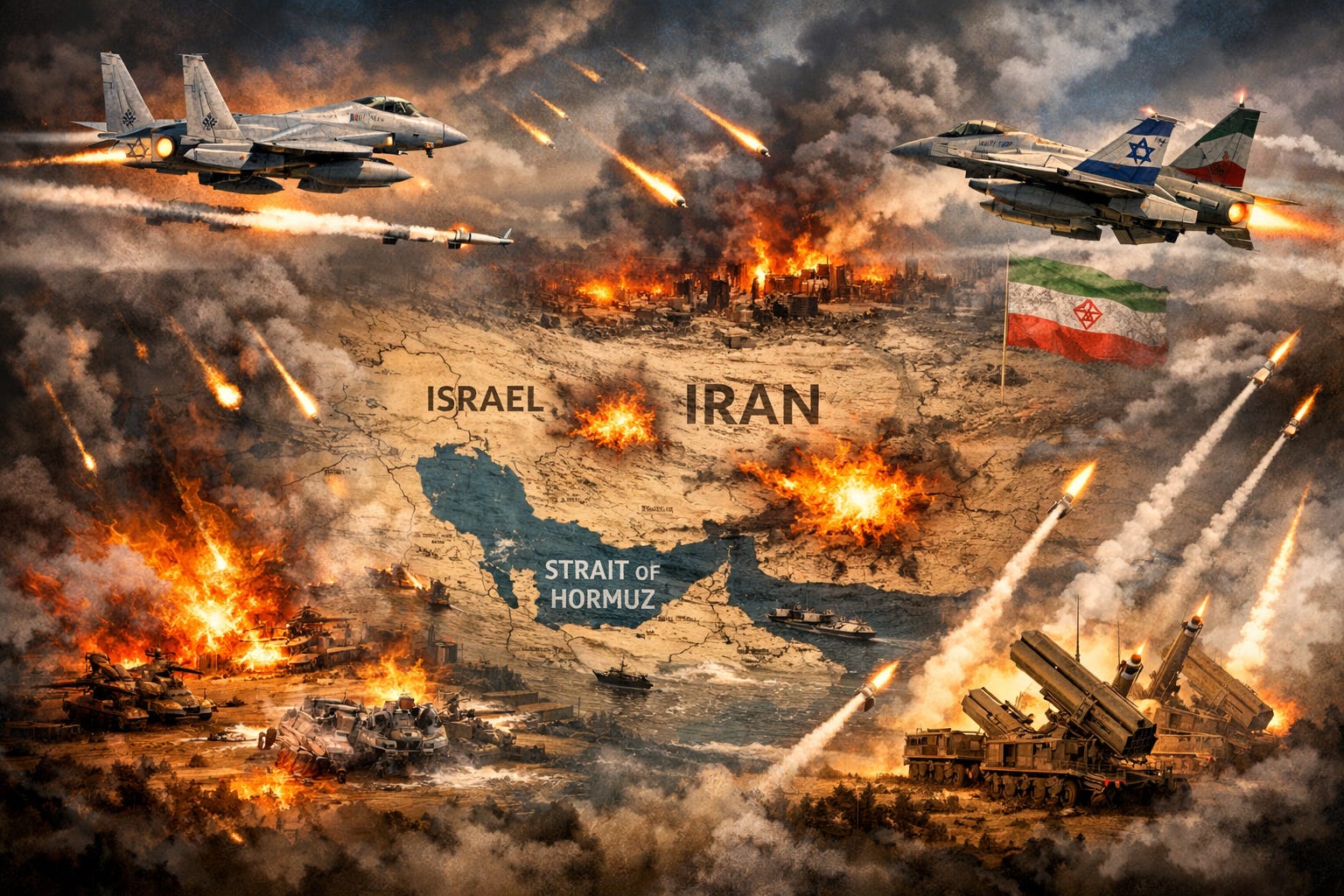
Struggling to keep up with what’s unfolding? Me too. Here are 10 legal issues to know from the first 10 days of war.
1. US/Israel’s legal justifications don’t hold up
A state can pre-emptively defend itself against an imminent attack under international law.
The US said Iran has “been an imminent threat for 47 years” — but nothing can be imminent for 47 years.
It also claimed it struck Iran pre-emptively to stop Iran retaliating against Israel — but that’s legally nonsensical, since the “imminent threat” was Iran’s response to an attack the US itself was planning. It’s the equivalent of punching someone to stop them punching you back for a punch you haven’t thrown yet. The US then publicly contradicted this justification.
Israel also said it has the right to defend itself — but with no imminent attack, it doesn’t.
2. Iran’s retaliation spilled over into attacking its own neighbours
Iran struck what it called “legitimate targets” in neighbouring Gulf states — but rather than limiting itself to US military bases, it hit civilian infrastructure like hotels and airports.
This took its response well beyond lawful self-defence, effectively making Iran the aggressor against the Gulf states themselves.
Those countries now have their own right to strike back — provided they do so proportionately.
3. Other Western countries’ roles
Italy, Switzerland, Belgium, Norway and Spain called the strikes illegal (yay!).
Germany backed the strikes in words but quietly withdrew its own troops from the region.
Canada supported “with regret.”
France criticised the strikes publicly but sent anti-missile systems to Cyprus to defend against Iranian attacks.
The UK stayed out of direct strikes but allowed the US to use its bases in Cyprus and Diego Garcia — possibly lawful only if those bases aren’t being used to attack Iran (though some would disagree).
Using Diego Garcia also sits uncomfortably with the International Court of Justice’s opinion that it belongs to Mauritius and a UK-Mauritius deal to hand it over that has yet to be finalised. Awkward.
4. Hezbollah’s involvement
After Khamenei’s killing, Hezbollah — an Iranian-backed armed group based in Lebanon — fired at Israel.
Israel struck back and launched a ground invasion of Lebanon.
Hezbollah would argue it was defending its ally Iran.
But even if Israel had a legal basis to retaliate, a full ground invasion goes far beyond what international law allows in self-defence.
5. Rules of warfare haven’t been respected
Civilians and civilian infrastructure (e.g., hospitals, schools, historical landmarks) have been hit by both sides.
The US bombed an Iranian girls’ school twice.
Iran — not a party to the Cluster Munitions Convention — used cluster munitions against Israel, still explicitly prohibited under the laws of warfare.
These could constitute war crimes if intent can be proven.
None of the main parties — US, Israel, Iran, Lebanon — are members of the International Criminal Court, making accountability difficult. But domestic accountability is still an option.
6. The war expands globally
A stray Iranian missile entered Turkish airspace on 4 March and NATO shot it down (Turkey is a NATO member). A repeat incident might drag all 32 NATO countries into the war.
A US submarine sank an Iranian warship off Sri Lanka.
Iran fired drones into Azerbaijan.
Ukraine offered its drone-interception expertise to Gulf states (joining the anti-Iran side).
The conflict is no longer contained to the Middle East – and the more countries drawn in, the harder it becomes to apply international law consistently.
7. Iran apologises to its neighbours
Iran apologised to neighbouring Gulf states for its strikes and pledged not to repeat them unless attacked first — both recognised forms of legal reparation under international law.
8. The Strait of Hormuz
Iran closed the Strait of Hormuz, through which roughly 20% of the world’s oil passes (so, prepare for higher energy bills!).
Whether it can lawfully restrict the Strait and attack other ships is covered in a separate post here.
9. The new Iranian leader and illegal threats against him
Mojtaba Khamenei has been named as Iran’s new leader.
But the US has said it must approve of the new leader or he’ll suffer the same fate as Khamenei.
This is a direct violation of the UN Charter’s non-intervention principle (Article 2(7)) — a state cannot dictate another’s leadership under threat of force.
10. Next steps
Trump demands “unconditional surrender” from Iran and said he’d get boots on the ground if necessary. Iran says bring it on.
This would open an entirely new chapter of legal violations. Watch this space.
SAIL hit 1000+ subscribers last week: THANK YOU! If this was useful, share it with someone trying to make sense of the news.
Other SAIL posts you might enjoy:
Imagine going after Iran for using cluster munitions (still held in US arsenals and deployed to Ukraine) on a country that is actively engaged in genocide.