


Source: UK, France, Germany, Italy and Canada condemn Israel's West Bank settlement project - BBC News
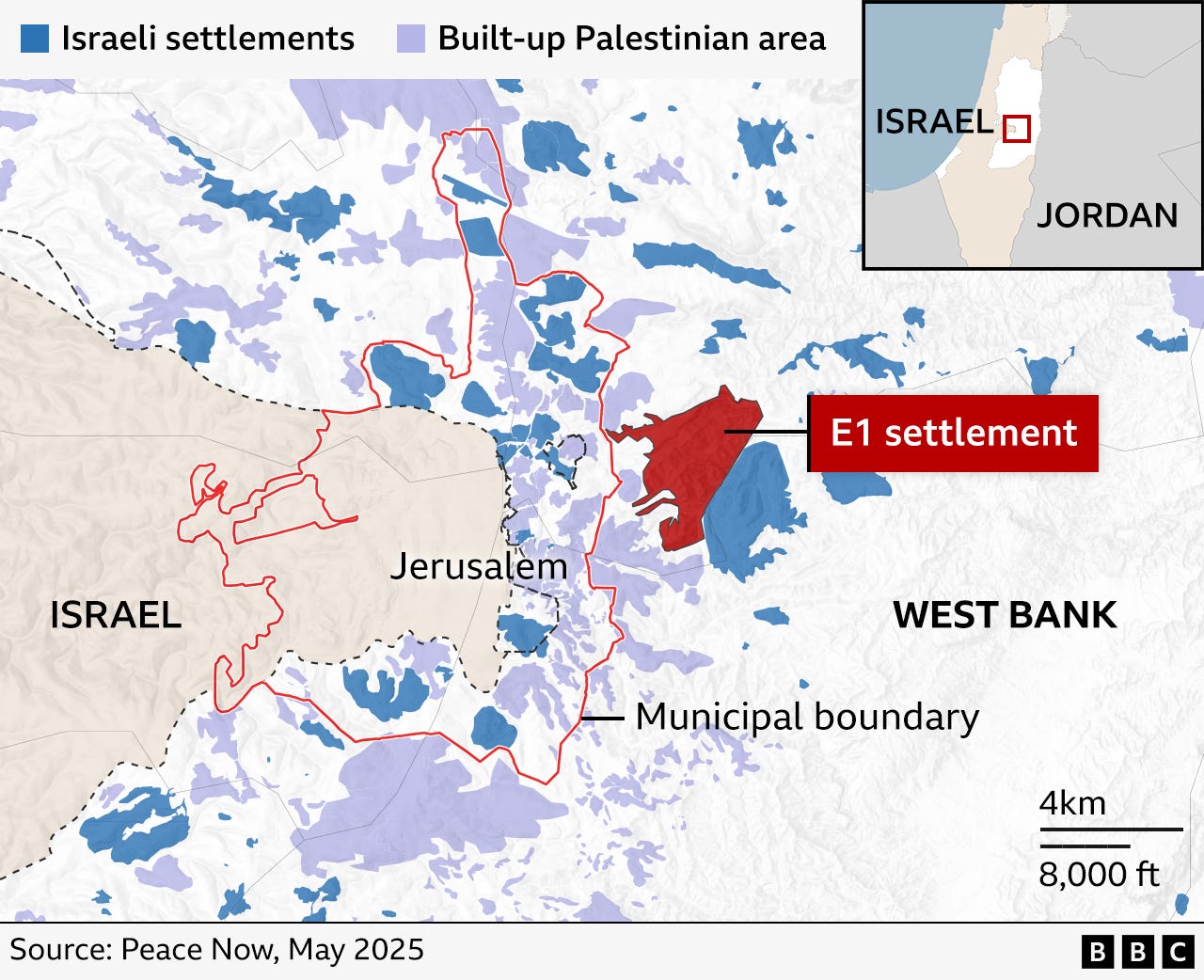
Israel opened bidding for 1,234 new homes in a place called E1: a strip of land that cuts the West Bank in half and blocks Palestinians’ access to East Jerusalem (their designated capital). This would make a unified Palestinian state pretty much impossible.
The deadline for bids is 19 October 2026, right before the Israeli election on 27 October. That way, the project is locked in before a potential new government can reverse them.
But the International Court of Justice (ICJ) issued an opinion in 2024 on exactly this situation. It spelled out (in meticulous detail, might I add) how and why settlement expansion like E1 breaks international law.
Let’s get into it.
It violates the ban on transferring your own civilians into occupied territory
The ICJ reminded us that the Fourth Geneva Convention (which Israel is party to) has one clear rule:
An occupying power (Israel) can’t transfer parts of its population in the territory it occupies (which includes the West Bank).
So any measures to organise or encourage civilian transfer, like this one, are illegal.
It treats occupation as permanent when it has to be temporary
The ICJ clarified that occupation is supposed to be a temporary response to military necessity. It doesn’t give the occupying power the right to claim the land forever.
E1 is designed to be permanent. When you build things that can’t be undone, you’ve broken that rule.
It’s illegal annexation
The ICJ said Israel has been carrying out annexation.
That’s when you either initially ‘house-sit’ but then declare the house your own (de jure annexation), or act like it’s your own by remodeling, moving the family in, changing the locks (de facto annexation).
Building settlements like E1 is an example of annexation, which is illegal.
It fragments Palestinian land into enclaves
The ICJ said Israel’s settlement policy “fragmented the West Bank and severed East Jerusalem from it” by “encircling Palestinian communities in enclaves”.
E1 seals this.
Cut up Palestinian territory and you are violating the right of the Palestinians to self-determination.
In other words, you’re taking away their ability to have their own independent state and control their own future.
It creates a coercive environment that forces Palestinians to leave
The ICJ said Israel’s settlement policy creates conditions where Palestinians have “little choice but to leave their area of residence”.
Israel doesn’t have to physically expel Palestinians. It just has to make staying impossible.
In the areas around E1, Palestinians lose access to land, water, and movement. The only rational option becomes… leaving.
It locks in territorial control before anyone can stop it
The ICJ warned about making settlements pretty much impossible to reverse.
And here, they’re locking E1 in.
There’s a reason the deadline is 19 October and Israeli elections 27 October.
Once bids are in and tenders are issued cancelling them becomes tough. A new government would face enormous pressure not to disrupt contracts, construction and investment. So the settlements become a fait accompli.
It segregates settlers and Palestinians
The ICJ said the separation between settlers and Palestinian communities is either racial segregation, or apartheid, or both.
E1 is part of that. It restricts Palestinian access and builds physical separation.
So what now?
Look, this opinion wasn’t a close call. On whether Israel should stop building settlements and evacuate settlers, 14 out of 15 voted yes.
Even if you have historical ties to land, you can’t use occupation and settlements to prove it.
Even if it’s “just an advisory opinion”, it carries real weight and lays out what states are obligated to do.
And finally, Western states have condemned E1… but condemnation without action is just words.
The ICJ opinion gives a clear blueprint of do’s and don’ts when it comes to Israel’s occupation.
Do’s: Block trade and investment that benefits the occupation, make it clear you don’t recognize Israeli territorial claims over occupied land, work to end obstacles to Palestinian freedom, etc.
Don’ts: No trade deals, no acting like the Israeli occupation is legal in diplomatic dealings, no aid/assistance that maintains the occupation, no business with Israeli companies profiting from settlements, etc.
They have options! The question is whether they’ll actually use them.
If you enjoyed this SAIL post, you might also enjoy: