


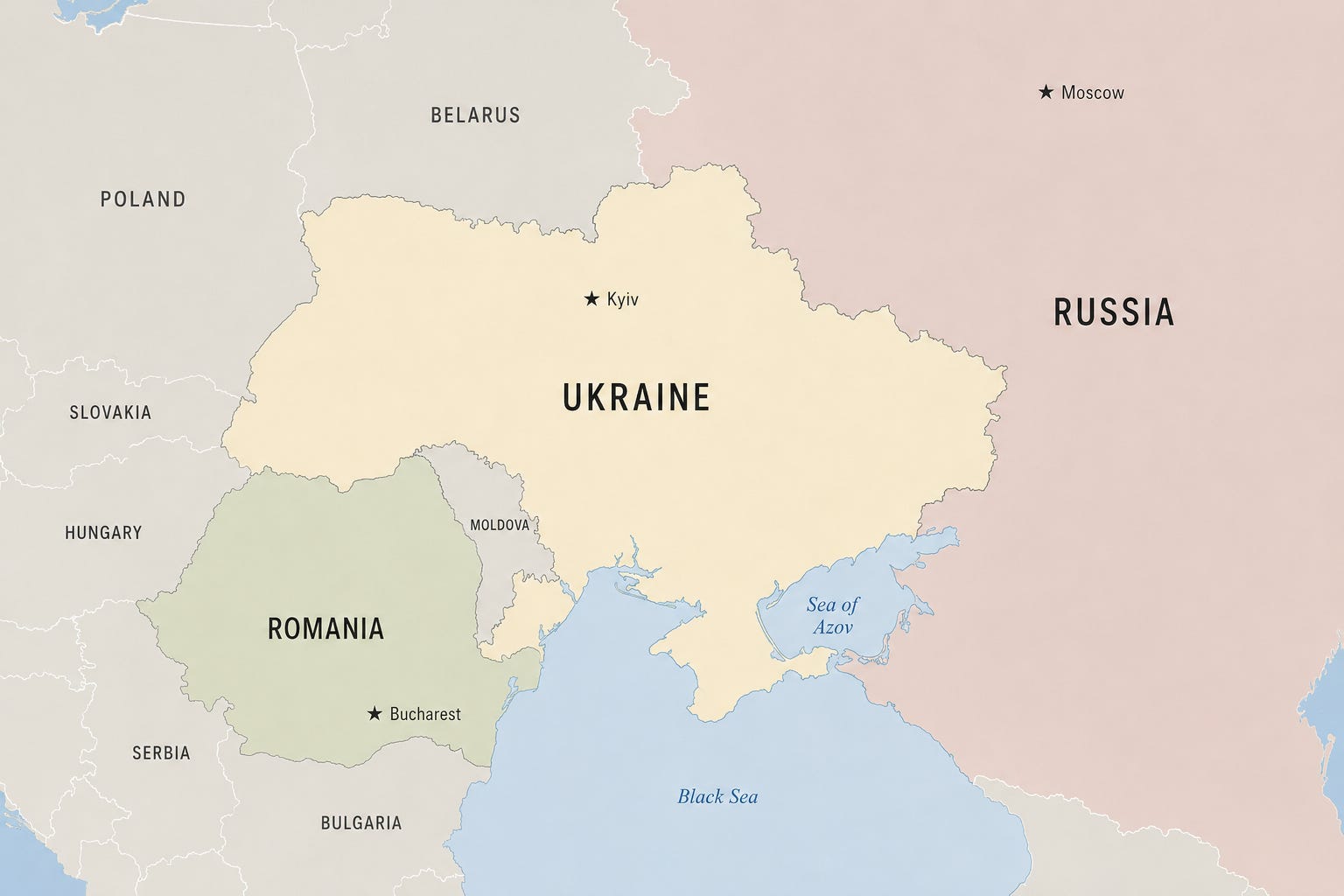
Yup, Romania’s just been roped into the ongoing Russia-Ukraine conflict.
1. Did this break international law?
Yes, almost certainly, on two separate grounds.
First, airspace sovereignty. A foreign military drone entering Romanian airspace without permission is a violation of its airspace under the 1944 Chicago Convention.
Second, the laws of warfare. Even though the conflict is between Russia and Ukraine, neither can attack the other without taking all precautions to avoid harming other countries.
2. Is Russia actually responsible?
Most probably.
Under international law, responsibility requires two things: breach (did it violate a legal obligation? I covered this above) and attribution (was this Russia’s drone?).
Putin denies that it was Russia’s drone and suggested the drone might be Ukrainian.
But Romania’s foreign minister confirmed that it was a Russian drone carrying explosives, based on forensic analysis of the wreckage.
Putin has disputed the finding and demanded access to the wreckage. It would strengthen Romania’s case to share the evidence or invite independent third-party verification, but it’s not legally required to.
3. Can Romania strike Russia back?
No.
Romania’s right to self-defence under Article 51 of the UN Charter requires an “armed attack”.
International law interprets that threshold as requiring scale and gravity beyond a single errant drone.
4. So what can Romania actually do?
Expel Romanian diplomats from Russia (which it has done).
Close consulates.
Demand reparations through diplomatic channels.
A bigger move: Romania is a party to the International Criminal Court and could refer the incident to the Court to the existing Ukraine situation.
It could frame it as a war crime, if it can be proven that Russia was intentionally directing attacks against Romanian civilians.
5. What can NATO do?
Romania is a NATO member. It’s considering invoking Article 4 of NATO’s treaty, which triggers formal consultations between NATO members when one of them is threatened.
But the big NATO move would be Article 5: all members will defend an attacked member (because an attack against one is an attack against all).
NATO hasn’t done this (yet?). It’s blamed Russia and condemned Russia’s move for now.
This could be because NATO doesn’t consider this to be an ‘attack’ in legal terms. It could also be because it’s reluctant to escalate this into a full-blown world war (fair enough!).
6. Now what?
These types of spill overs can happen. A Ukrainian missile struck Poland and killed two people back in 2022.
The law is clear. The solution? Make enough noise that neither Russia nor Ukraine does this again, and keep a record for the day of reckoning when the war finally ends.
Other SAIL posts you might enjoy: