


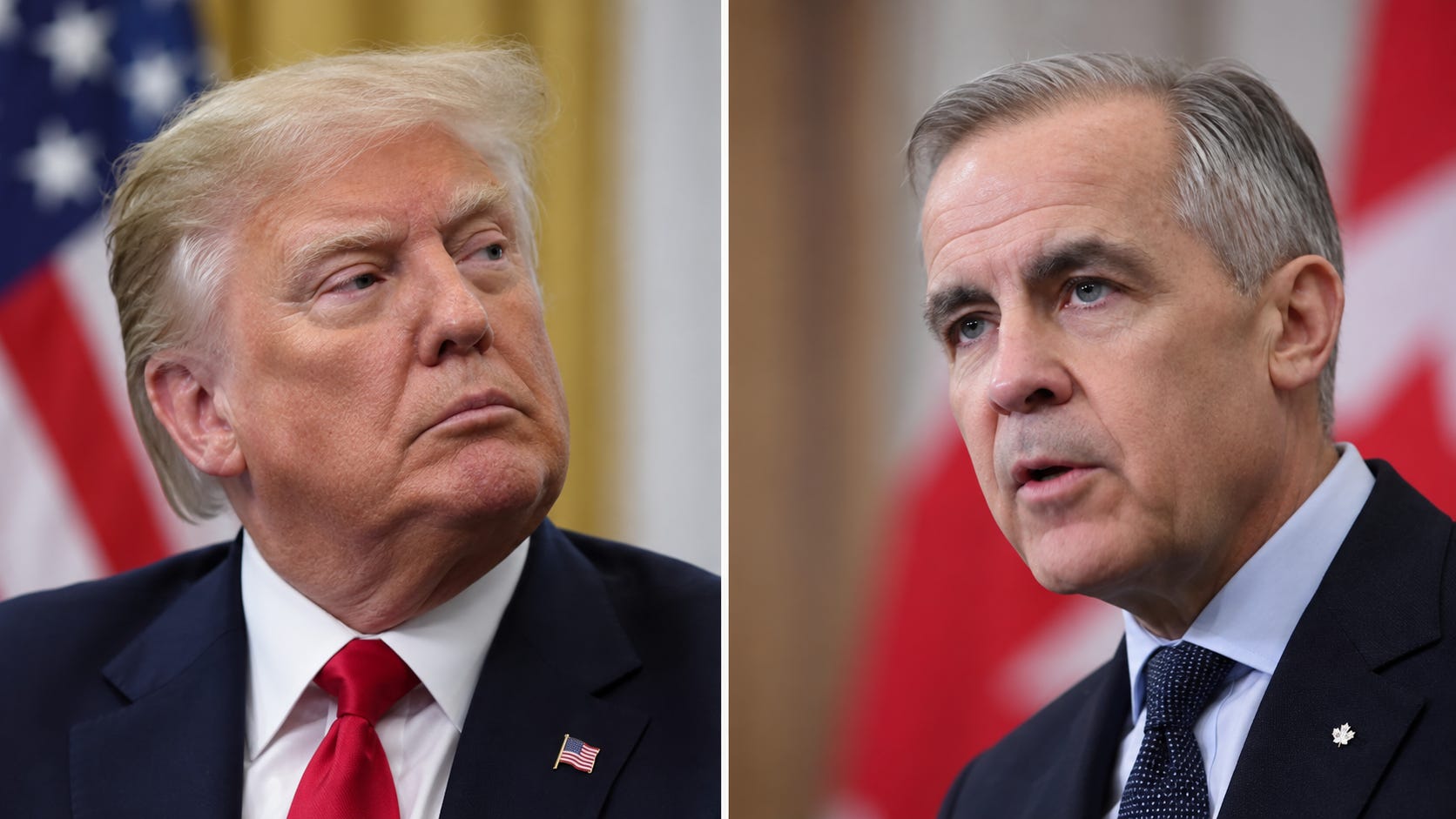
Trump just imposed 50% tariffs on ~$20 billion in Canadian goods (e.g.: cars, alcohol, dairy).
He started a trade war in early 2025, but this is the biggest tariff hike yet.
Why? He cites Section 338 of a U.S. law called the 1930 Tariff Act.
Section 338 says the President can impose tariffs of up to 50%, when a foreign country discriminates against U.S. commerce.
Trump argues Canada has been discriminating against U.S. products like cars, alcohol and dairy.
This move goes against the Canada-U.S.-Mexico Agreement
This move violates the Canada-U.S.-Mexico Agreement (USMCA) that has existed since 2020.
It has replaced the 1994 North American Free Trade Agreement (NAFTA) between them – which you may have heard of.
Like NAFTA, its goal is to make trade between these countries easier.
So through the USMCA, the U.S. and Canada agreed to specific tariff rates they’d stick to, for goods covered by the agreement.
Under its Article 2.4, Canada and the U.S. promised each other they wouldn’t raise tariffs above their agreed rates for those goods.
Trump’s 50% extra tariffs on Canadian goods violate this because those goods qualify under the USMCA.
It’s like promising your friend a price for something and then secretly charging extra anyway.
It also goes against global trade rules
Both the U.S. and Canada are part of the World Trade Organization (WTO).
Even though the USMCA is more specific, they also have to respect the general WTO rules.
Under the WTO, the U.S. committed to specific tariffs and its recent decision goes beyond (way!) those commitments.
Also, a core WTO rule is that members must treat all their trading partners equally.
Any perk given to one country is given to all countries in the trading club, so that no one is unfairly disadvantaged.
The U.S. move is quite the opposite of a perk and certainly disadvantages Canada compared to others.
What can Canada do?
Canada has retaliated with its own tariffs – yup, the war is on.
Canada’s legal leverage is strong here, as the U.S. move is illegal.
It goes against the USMCA and WTO rules, and you can’t use your domestic law as an excuse to violate international law.
But its political leverage is more complicated – especially as Trump is also using tariffs for bigger power grabs (e.g.: forcing Canada to give the U.S. control over its critical minerals, investments and future trade negotiations).
Still, Canada can…
Act under the USMCA:
The USMCA was reviewed in July 2026 and Trump said he didn’t want to move forward with it in its current form.
Unless Canada (and Mexico) can renegotiate terms to Trump’s satisfaction, it’s set to expire in 2036.
But it actually offers a dispute resolution system that Canada can still use today.
When countries disagree on something, they first try to resolve it through negotiation in 30 days.
If that fails, either the U.S. or Canada can request a panel. That’s a group of independent trade experts to decide if a measure violates USMCA – and possibly other trade disagreements between them.
The system is there: they should use it.
Act under the WTO:
Canada can also file a complaint to the WTO – it has in the past, and won.
Though the U.S. ignored this and imposed even more tariffs, I think it’s still worth doing it again to have a written record of illegal treatment and create (more) pressure.
Bonus points if Canada gets other countries to file fresh complaints, to amp up global pressure.
Diversify trade away from the U.S.?
Canada is the U.S.’s number one customer; it buys more from U.S. businesses than the UK, France, China and Japan combined!
So that would be a tough transition.
But Carney has said he’s working on it… and he has every reason to work faster!
If you enjoyed this post, you might also enjoy:
@Canadian Returnee I thought you might appreciate my latest! 😄
In many ways I think one can consider the US actions not as "tariffs" but as a form of economic sanctions.