

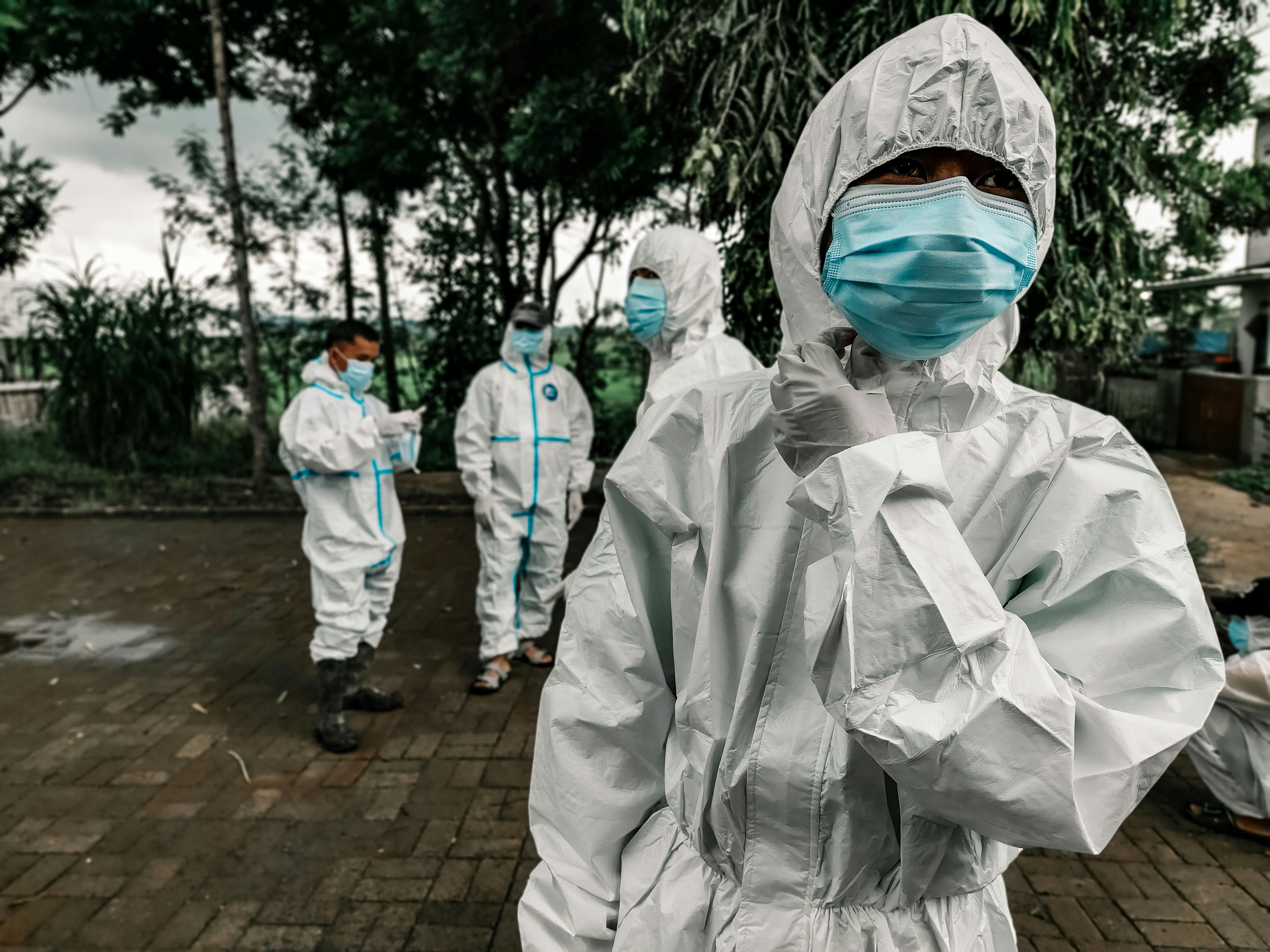
If you thought COVID-19 was bad, buckle up. Ebola doesn’t spread like COVID, but makes it look like a mild flu season.
Ebola’s been around since 1976, but these days it’s moving faster than ever: the 2026 outbreak is the largest ever recorded in its first month, and the head of Africa’s Centres for Disease Control and Prevention has warned it could be the worst Ebola outbreak on record.
The first case on European soil was also just confirmed in France.
Global health law tells countries what they should be doing when there’s an outbreak to keep everyone as safe as possible.
There’s some good news about how it’s developed lately, and some bad news.
Good news:
1. Countries are faster to report outbreaks
States have always had to report disease outbreaks to the World Health Organization (WHO).
The International Health Regulations (IHR), a binding treaty, required them to (Article 6). But report what, exactly, and when?
This wasn’t clear, and resulted in slower reporting until the IHR was recently amended.
Now, the legal trigger for reporting now explicitly covers unexplained clusters of severe respiratory illness, and even a handful of cases can qualify, before any lab has confirmed what’s actually causing them.
The bar for “this counts, tell us now” got lower.
Because of this, WHO got its first alert about this Ebola outbreak on 5 May 2026, based on an unusual cluster of deaths, before lab confirmation even existed. That’s much faster.
2. The WHO is faster to declare a public health emergency
The WHO has a practice of declaring an outbreak a Public Health Emergency of International Concern (PHEIC) when it gets to a critical stage needing serious collaboration between countries.
When Ebola broke out in December 2013, a PHEIC wasn’t declared until August 2014 (roughly 8 months later).
When it broke out again in 2018, a PHEIC wasn’t declared until July 2019 (roughly 11 months later).
This time (2026): the Democratic Republic of the Congo (DRC) officially declared the outbreak (once lab tests came in) on 15 May.
The WHO declared a PHEIC two days later, on 17 May.
That’s a totally different category of speed.
Bad news:
3. No enforcement
Surprise! If a state hides an outbreak, is unresponsive or uncooperative (breaching Article 6), there’s no penalty.
So for instance, contact tracing in this Ebola outbreak has reached ~45% of contacts, against WHO’s own 90% benchmark. But there’s no legal consequence.
The system is designed to be “non-punitive” and “non-adversarial”, by its own legal text (Article 54bis). It’s built to encourage, not enforce.
4. Equity’s still a problem
Equity means: resources and access to health aren’t split equally, but go where the need is greatest.
It’s become even more important after we witnessed vaccine hoarding by Western countries during COVID-19 (remember that? Good times :D).
The IHR amendments added “equity and solidarity” as a formal principle (Article 3) and a new financing mechanism meant to get vaccines and supplies to poorer countries during emergencies, though it hasn’t been tested yet.
Meanwhile, equity’s still a big problem.
When this Ebola outbreak hit DRC, the US wouldn’t bring its own exposed citizens home. Instead it tried to build a quarantine facility in Kenya… a country with zero Ebola cases.
The message Kenyans heard: ‘too dangerous for us, fine for you.’ That’s the equity gap the new treaty language is supposed to close, playing out in real time. Kenyan courts and ministers blocked this move.
Changing the law was the easy part. Changing how seriously states take equity will be the harder fight.
Conclusion: The law can spot an outbreak fast now. But it’s still not fair: it can’t make anyone pay for it or stop a rich country offloading risk onto a poor one. And until it is, every outbreak will keep exposing the same gap.
The topic of this post was requested by SAIL subscriber Naa (@naa1720920). If you have a topic making news headlines you’d like covered, drop a comment or contact hello@learnsail.org.
Other SAIL posts you might enjoy: