


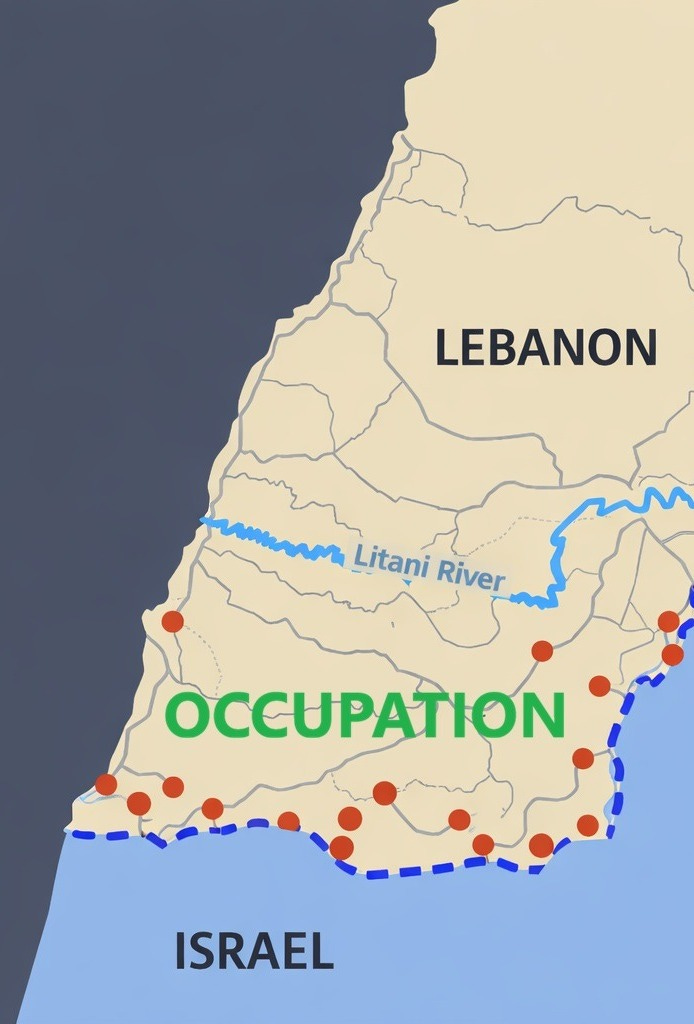
Israel launched a ground invasion of Southern Lebanon, targeting the area from its border to the Litani River (~22 miles/35km: huge!).
A country occupies another to control territory for protection or strategic advantage.
Occupation can be lawful or unlawful depending on why and how it’s done.
Israel’s grounds for occupation are unlawful (why it’s done)
Occupation is lawful only if it’s genuine self-defense or UN Security Council-authorised. Neither applies here cleanly.
After Khamenei’s killing, Hezbollah (Iranian-backed armed group in Lebanon) fired at Israel. Israel struck back and launched a ground invasion of Lebanon.
It’s debatable whether this is even self-defense. Here are the issues:
© SAIL 2026 - Do not reproduce without permission
(Shoutout to Edge Notes for the tip on presenting this table!)
But even if Israel had the right to self-defense, it violates international law by failing two tests:
Necessity: Israel could’ve simply stopped attacking Iran, and Lebanon already banned Hezbollah’s military activities.
Proportionality: A full invasion displacing hundreds of thousands is too big. Striking Hezbollah’s rocket sites or temporarily occupying a narrow border strip would be proportionate.
Israel’s conduct of occupation is also unlawful (how it’s done)
Even a legal occupation has strict rules: keep it temporary, don’t settle your people there, make no permanent changes.
Israel is breaking all of them because it’s carrying out annexation.
That’s when you’re supposed to be ‘house-sitting’ but you either declare the ‘house’ is yours (de jure annexation), or act like it by remodeling, moving your family in, changing the locks (de facto annexation)… or both.
Israeli Minister Smotrich explicitly declared the Litani River should be Israel’s new border: de jure annexation.
Netanyahu called for a “security zone” even post-war, a policy that would prevent hundreds of thousands of displaced residents from returning home: de facto annexation — and one that has hardened into permanence before, e.g., Israel’s 1982–2000 Southern Lebanon occupation, the Golan Heights, and the West Bank.
Why this matters
The world is distracted by the Iran war and the threat of the Strait of Hormuz closing. But annexation cannot be ignored; it was a primary trigger for WW2. The international system was built specifically to prevent it.
The UN Security Council must demand Israel withdraw (it has done so in the past) and the UN General Assembly can condemn this. It could also ask the International Court of Justice for its opinion, similar to the one it gave in 2024 about Israel’s West Bank occupation.
States must refuse to recognise annexation, condition military aid accordingly, and pressure Israel to pull out.
Letting this succeed tells every territorial aggressor the rules don’t apply when the world looks away.
If you found this useful, share it with someone who might find it useful too!
Other SAIL posts you might enjoy:
The US-Israel-Iran War Has Been Ugly. Here’s What International Law Says (in 3 minutes)
The Strait of Hormuz: A 3-Minute International Law Breakdown
10 Days, 10 Issues: The International Law of the US-Israel-Iran War (in 3 minutes)
Was Killing Iran’s Supreme Leader Lawful Under International Law? (In 2 minutes)
The U.S. and Israel Strike Iran: A 2-Minute International Law Breakdown
This’s a great, really insightful article. Thank you!