


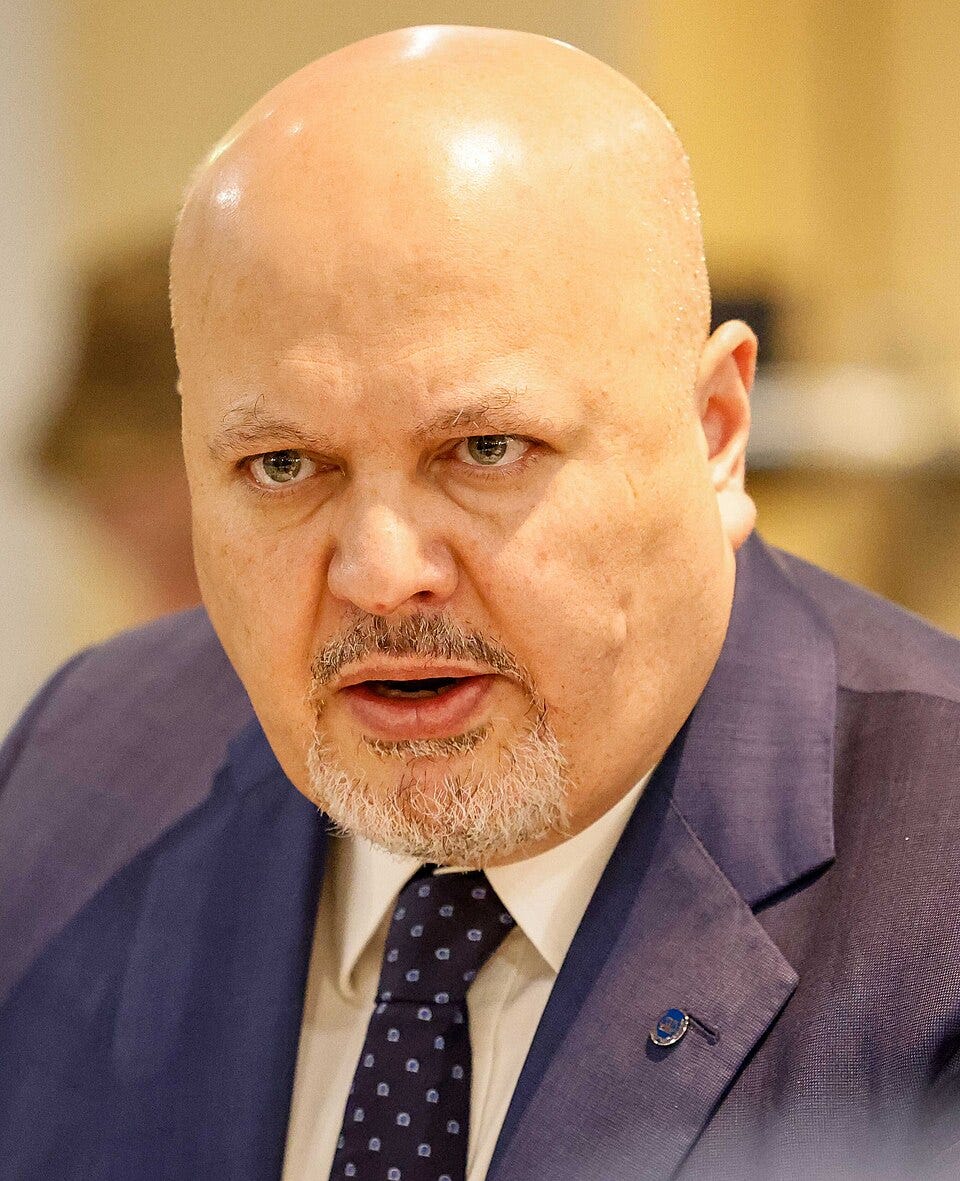
Photo credit: Raoul Somers (CC BY-SA 2.0)
.jpg/2)
The ICC is the court in The Hague that goes after criminals (not the other one in The Hague, the ICJ, that deals with disputes between countries).
The ICC’s prosecutor is the one who opens an investigation, gathering evidence and making a case that the matter should go to trial.
They’re the catalyst for the investigations in Myanmar, Venezuela, Palestine, Afghanistan, Ukraine, etc… and for arrest warrants on the likes of Netanyahu and Putin.
Karim Khan has held that role since 2021, but just got fired.
It’s the first time in the ICC’s 24-year history that a sitting chief prosecutor has been voted out of office.
1. Why was Karim Khan fired?
The vote focused on allegations of a sexual relationship between Khan and a member of his office staff.
Khan has consistently denied any wrongdoing. His supporters insist it is a politicised case in reaction to his pursuit of arrest warrants against Israel’s Benjamin Netanyahu.
This is the core controversy of this saga.
To be clear: misconduct allegations are serious and must be taken seriously. But the timing, the geopolitical context, and Khan’s own insistence that this is retaliation will hang over this removal permanently. The court cannot fully escape that shadow.
2. Who fired him?
82 out of 125 ICC Member States voted to remove Khan: well above the 63 needed.
Under Article 46 of the Rome Statute, a prosecutor can be removed for serious misconduct or a serious breach of their duties, with an absolute majority of ICC Member States.
3. What was the process for removing him like?
Long (almost two years)... and messy.
The Rome Statute sets out the grounds for removal, but gives almost no guidance on how the process should actually work in practice… probably because no one anticipated it would ever be needed.
So when it was, everyone kind of improvised: there were disagreements about how much proof was enough to justify removing him, the voting procedure, and who had authority to do what. More detail on the procedural issues in my last post. The whole thing looked like it was being stitched together as it went along.
Khan’s team argued that the process was fundamentally unfair.
So that doesn’t help the ICC’s optics either.
4. Who will be the next prosecutor?
We don’t know yet.
But after this incident, whoever takes this role must be prepared for immense pressure.
Pressure to be of high moral character, obviously (as Rome Statute Article 42 requires).
Pressure from the U.S., who declared war on the ICC only days ago.
And — if you believe the removal was a response to the Netanyahu warrant — pressure to decide whether to actively pursue it… or let it die.
5. Can Netanyahu’s arrest warrant be dropped by the next prosecutor?
No.
In this case, the warrants were already reviewed and approved by the ICC’s Pre-Trial Chamber: the small panel of judges whose job is to oversee a case before it goes to trial.
So the warrants stay, unless those judges decide to drop it (Article 58(4) of the Rome Statute).
(The U.S. is pressuring them to through sanctions, but so far they’re holding firm.)
Still, a new prosecutor could still slow down the process significantly… to an almost-halt.
At this stage, before Netanyahu is arrested or appears in court, the prosecutor is still investigating, still pushing states to cooperate, and still maintaining diplomatic pressure on countries to arrest him if he enters their territory.
A new prosecutor who stops doing those things (e.g.: stops investigating, doesn’t add any new charges, sends fewer cooperation requests, etc.) can effectively let the case go cold without ever formally dropping it.
6. How will the next prosecutor be selected?
The same body of 125 states who just voted to remove Khan will elect his replacement, by secret ballot.
Expect the process to take months, be closely watched and fiercely contested.
The outcome might tell us a lot about the direction the ICC intends to take.
Other SAIL posts you might enjoy:
Thank you
This advances open source AI Judicial modernizing and or or starting international justice in a genuinely neutral non NATO group of states
credibility is largely lost and integrity never really existed