


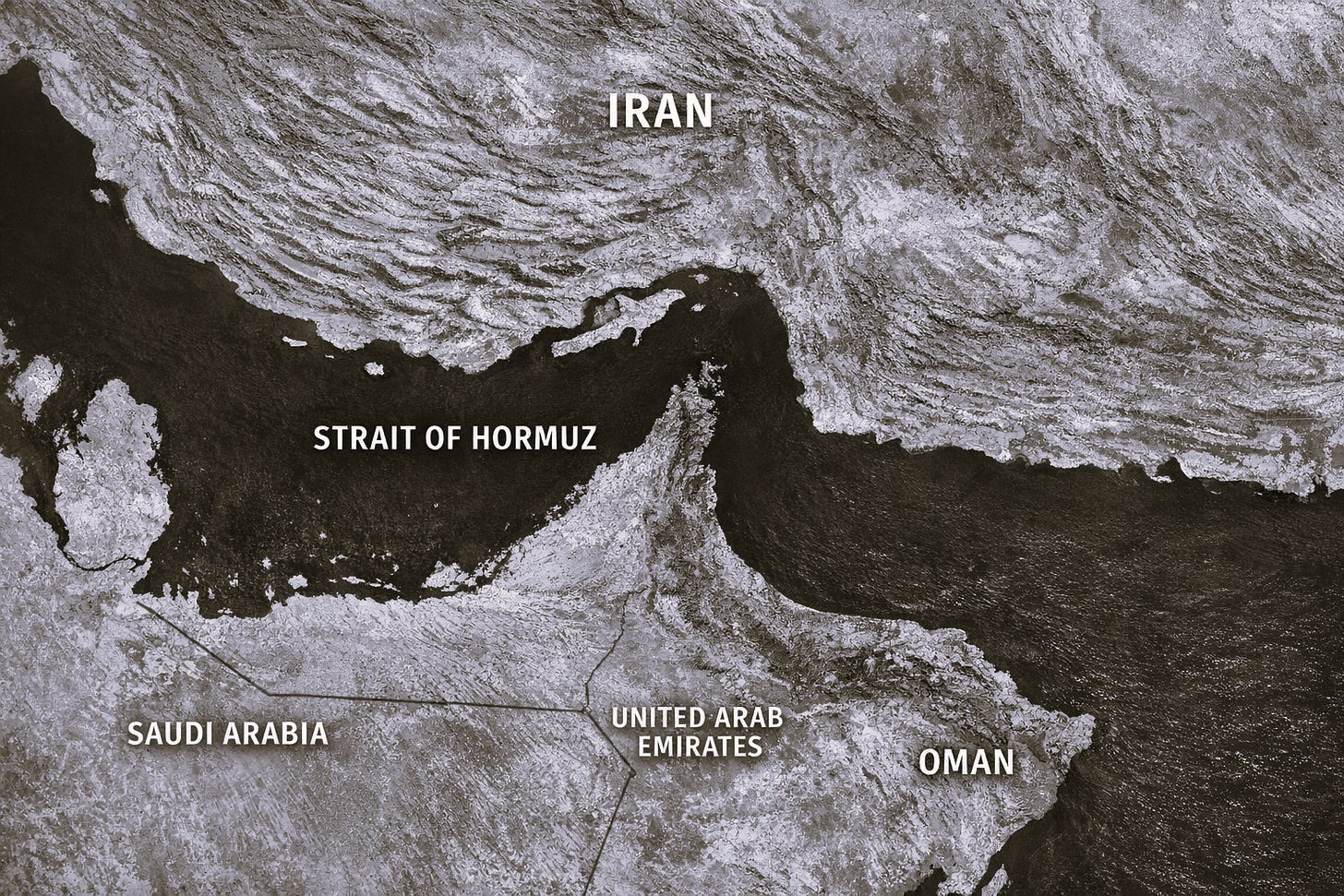
[The usual caveats apply: this is a simplified explainer, lawyers disagree on several of these points, and by the time you read this, something may have already changed.]
The legal controversies around the Strait of Hormuz matter: they shape what the U.S. and Iran can demand in negotiations, what other countries can push back on, and give you the full picture of the ongoing conflict. So, let’s get into it!
What law(s) govern the Strait of Hormuz?
The Strait is governed by the regime of transit passage under the UN Convention on the Law of the Sea (UNCLOS), giving all ships the right to sail through it.
But Iran isn’t a party to UNCLOS, and it’s not 100% clear in international law that transit passage rules are so universal that they apply to Iran regardless.
So Iran says: this doesn’t apply to us.
(I covered this in more depth in a previous post.)
Is Iran violating countries’ freedom of navigation by closing the Strait?
Yes.
Freedom of navigation is a general principle that ships should be able to move freely.
It’s so widely accepted that it almost certainly applies to all countries, whether or not they’ve signed UNCLOS.
There are some maritime zones where restrictions apply, but completely closing an international strait like Hormuz violates this freedom (as well as transit passage rules).
So even if Iran successfully argues “UNCLOS doesn’t bind me, so the transit passage rules don’t apply”, it must still respect the freedom of navigation and let ships pass through the Strait.
People keep saying the Strait of Hormuz is part of ‘international waters’. Is it?
No.
‘International waters’ isn’t a legal term.
The closest term that exists is “high seas” – parts of the world’s oceans that no single country controls (roughly 70% of the Earth’s surface).
But the Strait of Hormuz isn’t in the high seas. It’s clearly in Iran and Oman’s territorial waters.
Is the U.S. imposing a naval blockade on Iran lawful?
Probably not.
International law allows a country (e.g. the U.S.) to hit back when another country (e.g. Iran) breaks the rules. These are called countermeasures.
But there’s a hard limit: countermeasures can’t involve the use of force.
And parking warships outside someone’s ports to stop ships getting in or out is using force under international law.
The only two things that can make this use of force legal are UN Security Council approval or self-defence.
Neither applies here: the Security Council hasn’t signed off on it, and self-defence only kicks in if the U.S. had actually been attacked.
Most would say closing the Strait doesn’t qualify as an ‘armed attack’, though some disagree.
So the U.S. naval blockade is likely illegal.
Can other countries impacted by the U.S. blockade do anything?
Yes.
Countermeasures can’t be exercised against third parties that haven’t done anything wrong (e.g., the U.S. turning away Indian ships bound for Iran, or oil tankers serving European countries).
The U.S. could be liable to those third countries for any harm caused.
They can formally protest (e.g., summon the U.S. ambassadors) or even negotiate compensation (though getting the U.S. to actually pay up is another matter entirely…).
Is the way the U.S. naval blockade is being carried out lawful?
Probably not.
Separate from whether the blockade should exist at all, there’s the question of how it’s being enforced. And it’s not looking great here either.
Under the international law rulebook for naval warfare, the U.S. ticks some boxes: it announced the blockade publicly and is applying it impartially to all countries’ ships.
But two problems:
First, a blockade is only a recognised legal tool during armed conflict. But there’s currently a ceasefire in place (i.e. no armed conflict), which raises the question of whether the US can legally use it at all?
Second, Iran’s coastline is 1,100 miles long, the U.S. is operating alone and has asked for help, and it seems like a massive undertaking. That raises questions about whether the blockade meets the legal requirement of effectiveness.
So… the blockade likely isn’t clearly being lawfully carried out either.
The U.S. attacked and captured an Iranian cargo ship trying to get past its blockade of Iran’s ports. Was that lawful?
If the blockade is unlawful (which is likely), neither attacking nor capturing the ship is justified.
For those who argue the blockade is lawful, then capturing it is lawful but attacking it without prior warning isn’t.
Iran wants to charge tolls for ships to pass through the Strait. Is that lawful?
Probably not, but it’s hard to enforce.
UNCLOS explicitly forbids it, but Iran isn’t a party to UNCLOS.
It’s also not 100% clear that this rule on tolls is so universally widely accepted that it applies to Iran regardless.
And unlike the Suez Canal, Panama Canal or Bosphorus, which all have/had their own specific international treaties governing passage and fees, no such treaty exists for the Strait of Hormuz.
How does this all impact the ceasefire?
It puts enormous strain on an already fragile agreement.
Neither side is fully complying: Iran is (still) closing the Strait, the U.S. is imposing a blockade, and each is accusing the other of ceasefire violations. Yikes.
It also highlights why any lasting deal has to resolve the Strait question directly.
Right now the two sides couldn’t be further apart: Iran wants full recognition of its sovereignty over the Strait, the U.S. wants a guarantee it can never be closed again.
Let’s see what happens.
If you found this useful, share it with someone who might find it useful too!
Other SAIL posts you might enjoy:
The Strait of Hormuz: A 3-Minute International Law Breakdown
Five Reasons the US-Iran Ceasefire Is Legally Fragile (in 3 minutes)
Israel’s Occupation of Southern Lebanon: A 3-Minute International Law Breakdown
The US-Israel-Iran War Has Been Ugly. Here’s What International Law Says (in 3 minutes)
10 Days, 10 Issues: The International Law of the US-Israel-Iran War (in 3 minutes)
Was Killing Iran’s Supreme Leader Lawful Under International Law? (In 2 minutes)
The U.S. and Israel Strike Iran: A 2-Minute International Law Breakdown
Hi Yusra, Your note is very informative and clear knowledge for understanding the strait of Hormuz & the UNCLOS.
Thank You for enlightening us in the legal paradigms of this conflict.
I share my thoughts on the derailing impact it inflicts on the already existing fragile ceasefire agreement. Now with the seizure of the Iranian tank that occurred over the weekend due to the US blockade, doesn't this exacerbate diplomatic and negotiation measures? Additionally, the thousands of troops from US that where deployed in the Middle East, what message does Iran pick from this! To me, it becomes difficult to fully trust a party that has violated the trust, no wonder the negotiations in Islamabad flopped after 21hours effort. Nevertheless, we hope ultimately that Diplomacy shall prevail.