


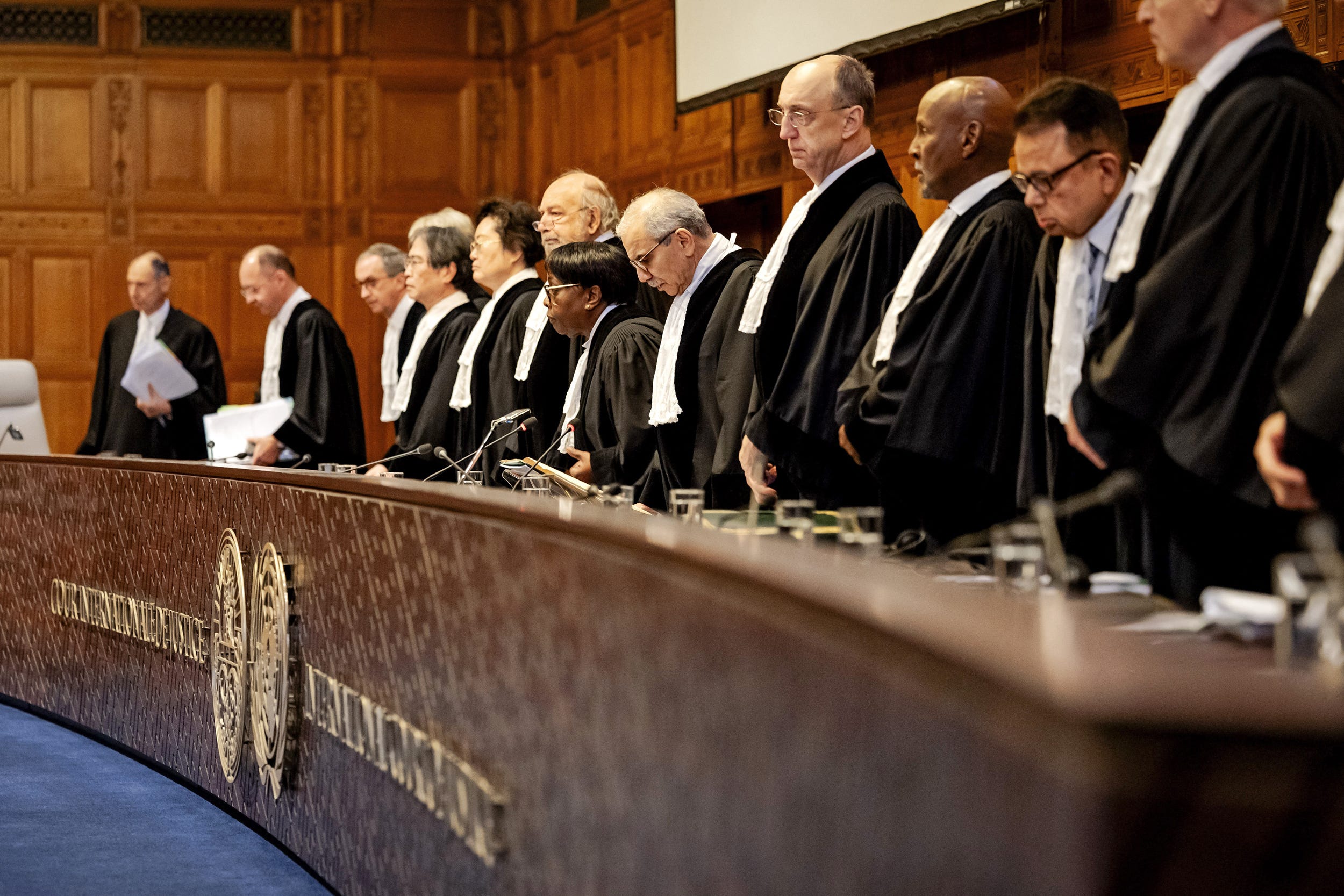
Four more countries just showed up to the world’s most watched court case: Namibia, Hungary and Fiji and… the U.S.!
What’s the South Africa v. Israel case?
In December 2023, South Africa sued Israel at the International Court of Justice (ICJ): the world’s top court for disputes between countries.
It accused Israel of committing genocide in Gaza in violation of the 1948 Genocide Convention.
That’s a treaty that 153 countries have formally committed to (including both South Africa and Israel) that outlaws genocide and requires every member to prevent it.
What are “interventions”?
While the Court works through the case, other countries can formally weigh in.
There are two ways to do it, but the relevant one here is Article 63: if a case turns on how to interpret a treaty, any country that is party to that treaty has the right to jump in and declare they want to explain what they think the treaty means.
Crucially, if a state gets to explain, the Court’s interpretation in its judgment will be equally binding on them — so they have real skin in the game.
Why are these interventions a big deal?
First, the case has become one of the most closely watched disputes ever heard by the ICJ.
Second, 22 countries so far – including the U.S. – have intervened… which is extraordinary!
Historically, interventions were rare and dry… and with one intervenor per case, at best.
Now they’ve become a way for multiple countries to signal who they support politically, and publicly plant their flag.
What are the 22 countries saying?
The ICJ doesn’t find genocide easily. Across the entire Yugoslav conflict — years of war, hundreds of thousands dead — it found genocide in just one place: Srebrenica. And even that single finding, in Bosnia v. Serbia (2007), came with a sting: the Court refused to hold Serbia responsible for it. In Croatia v. Serbia (2015), it found no genocide at all. Both outcomes were widely criticised.
So what’s at stake with these 22 interventions is essentially: how easy or hard should it be to prove genocide happened in Gaza?
18 are siding with South Africa.
Their arguments broadly push the Court toward a more expansive reading of the Convention — e.g.: assess intent holistically, not act by act; recognise that children’s particular vulnerability lowers the harm threshold; and don’t make this impossibly difficult to prove.
The message, broadly, is: the Convention exists to protect people. Use it.
4 are siding with Israel: the USA, Hungary, Fiji and Paraguay (Paraguay says its neutral, but its legal arguments are pro-Israel)
Their arguments push the opposite way — keep the bar high. E.g.: Genocidal intent must be the only reasonable conclusion from the evidence. Civilian casualties in urban warfare don’t prove genocide. Letting this case succeed risks turning every armed conflict into a genocide claim before the ICJ.
The message, broadly, is: genocide is the gravest crime in international law. Don’t dilute it.
The U.S. goes furthest: calling the allegations simply false, framing them as part of a long-running effort to undermine Israel, and reminding the Court that the U.S. helped write the Convention, so its interpretation should carry weight.
Is it a good thing that they’ve intervened?
Politically, yes. It signals that this is an issue the world is watching, and puts states’ views on the record for history.
Procedurally, it’s more complicated. More interveners means more written submissions, more arguments for the Court to work through, and more time. And while the lawyers argue, Gazans are still dying.
What next for the 22 interveners?
They’ve filed their declarations saying they want to intervene. The Court will decide whether to let each one go further.
If admitted, interveners get to file fuller legal arguments later in the process, and may get to speak at the main hearings too — though that’s the Court’s call.
Neither South Africa nor Israel is obliged to engage with any of it... But both have every incentive to lean on the interventions that help them and push back on the ones that don’t.
What next for South Africa and Israel?
The case is now grinding through the full legal process: South Africa filed its main written arguments in October 2024, and Israel filed its counter-arguments on 12 March 2026.
South Africa has the right to reply to Israel (and probably will), and Israel the right to reply to South Africa’s reply (so we should expect that!).
After that, oral hearings will take place.
A final ruling is still years away — 2028 is my guess.
Will the ICJ say Israel has committed genocide in Gaza?
Maybe, maybe not.
But worth noting: the Court is simultaneously dealing with another genocide case — whether Myanmar committed genocide against the Rohingya.
That judgment will likely come first, and the way the Court reasons through it will be a strong signal of how it might approach this one.
(A few of the same countries have intervened in that case too.)
Stay tuned!
If you found this useful, share with someone who might find it useful too!
Other SAIL posts you might enjoy:
Dr Suedi,
Will the court consider the views of genocide scholars who have expressed professional opinions or written peer-review papers on the matter? Thank you for your helpful articles.
Serious question: to legally qualify as genocide, there has to be genocidal intent, but the intent can not be determined from the actions or the consequences -- only from statements of intent. Is my understanding correct on that?
If so... does no one else see the... uh... issue with that?
Being able to commit genocide as long as you aren't as honest as Hitler about your intent?