


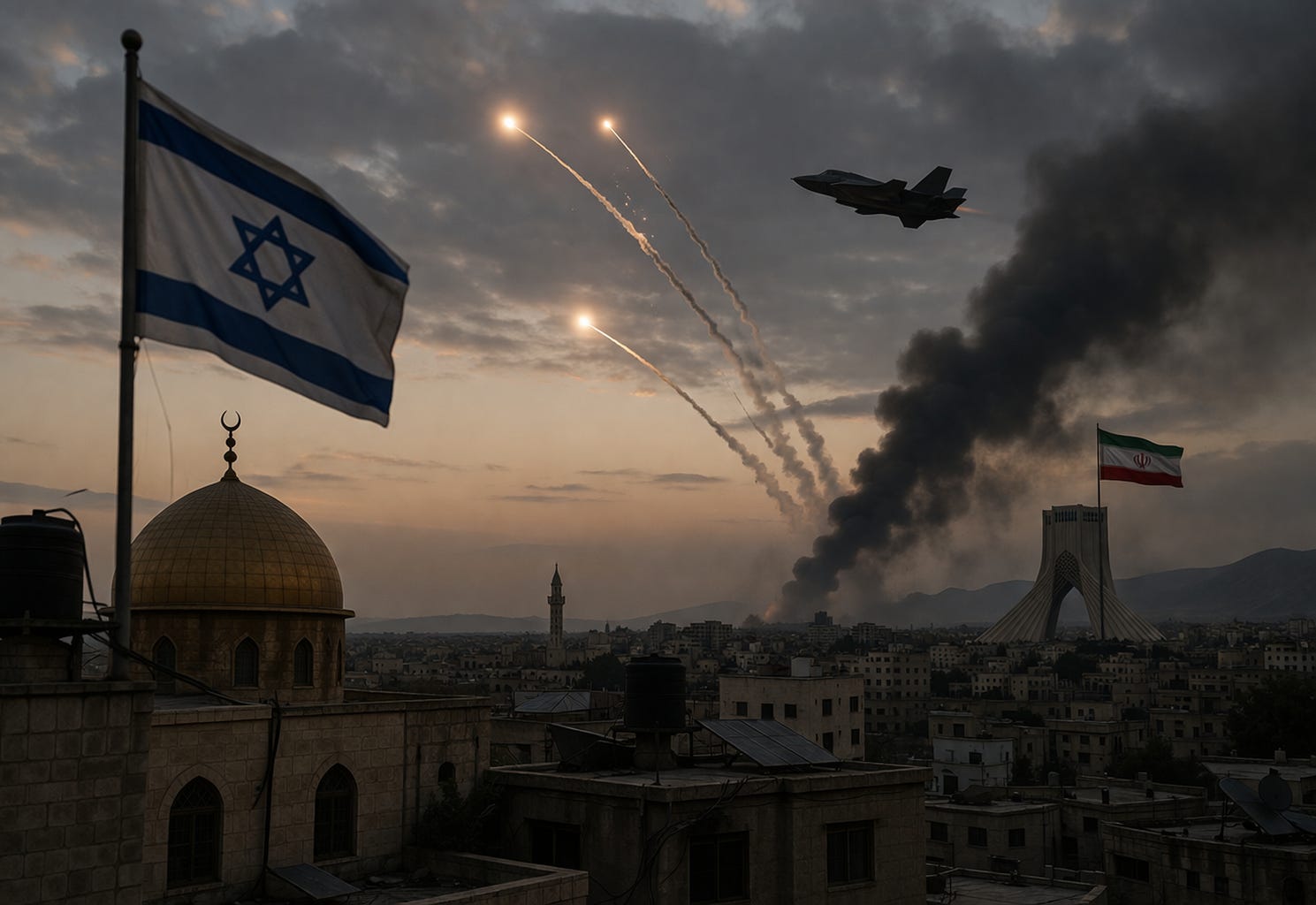
International law doesn’t just regulate whether you go to war. It regulates how you fight.
And this fight has been ugly. Here’s what the law says.
1. Targeting Energy Infrastructure
Israel struck large fuel storage tanks in Tehran, causing immediate shortages.
The U.S. bombed Kharg Island, Iran’s main oil export terminal, handling roughly 90-95% of all Iranian crude exports.
Iran has targeted energy infrastructure in Israel and neighbouring countries in return.
Trump threatened to obliterate Iranian power plants within 48 hours if Iran didn’t reopen the Strait of Hormuz (...then backed down hours later, saying the two sides are holding “productive conversations.”)
The logic is simple: cut the fuel, and you cripple the military (jets, tanks, and missiles all run on it). Cut the oil revenue, and you strangle the economy (yup… we’re all cooked!). And when civilians can’t heat their homes, move food, or keep hospitals running, pressure on governments rises fast.
The International Red Cross has been clear: Energy infrastructure is part of civilian infrastructure, and attacking it is prohibited unless it qualifies as a military target.
And even then, the anticipated civilian harm (fuel scarcity, loss of heat, hospital outages) can’t be disproportionate to the military advantage gained. Economic or political benefits don’t count.
Collective punishment is also prohibited: You can’t deliberately harm an entire civilian population to pressure its government.
2. All parties are killing civilians
Israel’s strikes on Tehran’s fuel storage tanks triggered toxic ‘black rain’: oil-saturated rainfall that poisons water supplies, damages crops, and causes serious breathing problems.
Israel used white phosphorus in residential areas of southern Lebanon. It burns through skin and bone and cannot be extinguished. The injuries are devastating, often fatal.
Both sides have been killing civilians and destroying civilian infrastructure (e.g., schools, hotels, apartment buildings, hospitals, historical landmarks) in Iran, Lebanon, Israel, and neighbouring countries.
All of this violates the core rules of warfare:
Distinction: you must tell civilians and military targets apart, and only hit military targets.
Precaution: you must take all feasible steps to avoid civilian harm.
Proportionality: you can’t cause massive civilian harm to achieve a minor military goal.
And if you’re not sure whether a target is military or civilian, you must assume it’s civilian. If it’s used for both, it can only be attacked if it is genuinely helping military operations.
3. Are Israel/U.S./Iran bound to these rules?
Yes.
The Geneva Conventions (that all are parties to) protect civilians and hospitals.
But the specific rules of distinction, precaution, and proportionality are most clearly codified in Additional Protocol I. The U.S./Israel/Iran aren’t parties to that.
White phosphorus in civilian areas is addressed by the Convention on Certain Conventional Weapons, a treaty neither the U.S. nor Israel is party to.
But these rules are so widely accepted that they bind everyone, treaty or not.
Iran isn’t off the hook, by the way. Who started the conflict is a separate legal question from how it’s conducted. Once at war, the laws of warfare bind everyone equally: aggressor and defender alike.
And there is no lawful “tit for tat”: What the other side did first is never a legal justification to do the same.
4. Who can be held accountable?
Military commanders and heads of state can be prosecuted.
(Heads of state often claim immunity though, so getting them into a courtroom is a different matter entirely…)
The charges would likely be war crimes and crimes against humanity.
War crimes are specific prohibited acts during war time, e.g., hitting a hospital, using white phosphorus in civilian areas, deliberately killing civilians. A single strike can qualify.
Crimes against humanity are bigger: either a large-scale attack on a civilian population, or a systematic pattern of them (not a one-off).
The same act can be both crimes simultaneously.
The main venue for prosecution is the International Criminal Court (ICC). The problem: none of the relevant parties (U.S., Israel, Iran, Lebanon) are members.
Iran or Lebanon could join the ICC and trigger investigations into U.S. and Israeli conduct on their soil.
This would be a bold move as U.S. law allows the President to use ‘all means necessary’ to free U.S. or allied personnel from ICC custody in The Hague (yes, really), and the U.S. is actively crippling it as we speak over its arrest warrants on Israeli leaders. On top of that, joining would expose Iran/Lebanon’s own conduct to scrutiny too. So, not impossible, but a lot to swallow.
Beyond the ICC: Some countries allow their courts to prosecute serious crimes no matter where they happened or who committed them. It’s rare, but it’s real… and it means a U.S., Israeli or Iranian military commander could theoretically be arrested the moment they land in the wrong country.
If you found this useful, share it with someone who will find it useful too!
Other SAIL posts you might enjoy:
Hersch Lauterpacht famously wrote: ‘If international law is, in some ways, at the vanishing point of law, the law of war is, perhaps even more conspicuously, at the vanishing point of international law.’
Yes I agree with this analysis. In the war, it should not be associated to the war of the jungle but even in the confines of war, there precautionary measures that can be taken to safeguard the innocent, neutral vulnerable people involved. I hope that ultimately there will be a diplomatic and negotiating platform to halt the mayhem that may put the entire world at stake.