


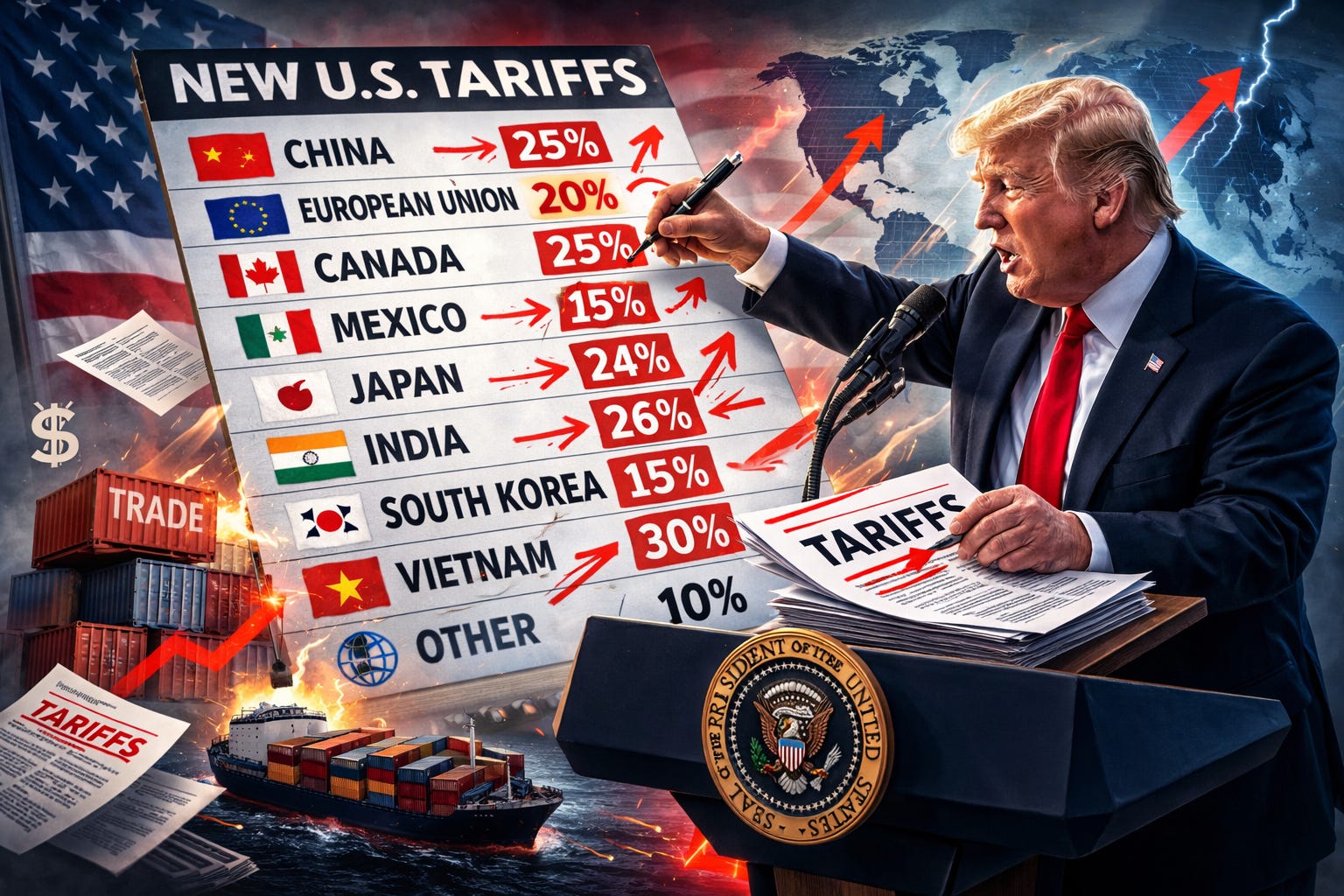
Trump just slapped a new 10% (quickly raised to 15%), global tariff on imports after the U.S. Supreme Court ruled his earlier ones illegal. Since taking office, he’s rolled out tariffs nonstop.
Tariffs are allowed under international law
A tariff is a tax on stuff imported from other countries. If you live in the U.S., a tariff makes a T-shirt brought in from Japan a bit more expensive, so that you’ll buy a T-shirt made in the U.S. instead.
That’s allowed, and all countries do it, to protect their local businesses.
But there are limits – and Trump is breaking them
Trump’s tariffs aren’t always being used to protect U.S. industries; they’re political tools to pressure other countries, gain publicity, or punish non-compliance.
International law doesn’t regulate motivation, only how tariffs are applied:
First, countries must commit to the maximum tariffs they’ve set for themselves, on specific products (see all commitments here; U.S. commitments are only published through 2024, before Trump’s second term).
Second, you can’t charge higher tariffs to some countries but not others.
Trump’s tariffs go beyond these limits and target certain countries at random, making them illegal under international trade law.
The World Trade Organization (WTO) exists to monitor and enforce these rules.
No exceptions apply
Under Article 21 of the General Agreement on Tariffs and Trade (GATT), countries can take trade actions they think are needed to protect their core security interests.
Trump has used this to justify his tariff policy.
But this exception is limited.
It only applies in extreme situations like war or a genuine emergency in international relations.
The WTO clarified this in the Russia – Traffic in Transit case (2019).
It also ruled that national security cannot be used as an excuse to get around trade rules (para. 7.133).
How countries have been pushing back
Many countries have called for a return to WTO rules, negotiating directly with the U.S. (e.g., China, EU) and filing WTO complaints over tariffs on steel and aluminium (e.g., China, Norway, Switzerland, Turkey) as well as other products (e.g., Canada).
The WTO so far ruled the national security exception didn’t apply to steel/aluminium tariffs, but the U.S. ignored it and imposed even more!
What happens next?
The WTO’s dispute system is already weakened because the U.S., frustrated by rulings against it, blocked appointments to its appeals body.
But my take: countries need to keep pushing for a return to WTO rules. Filing complaints and creating legal pressure still matters.
Many have also imposed retaliatory tariffs (e.g., EU) – risky, yes, but it can push the U.S. to renegotiate or rethink its policies.
Other strategies include diversifying trade away from the U.S., which reduces American leverage… at least, until the next administration.
We’re almost at 1,000 SAIL readers; thank you! If you like SAIL, share it!