


It’s been an eventful weekend.
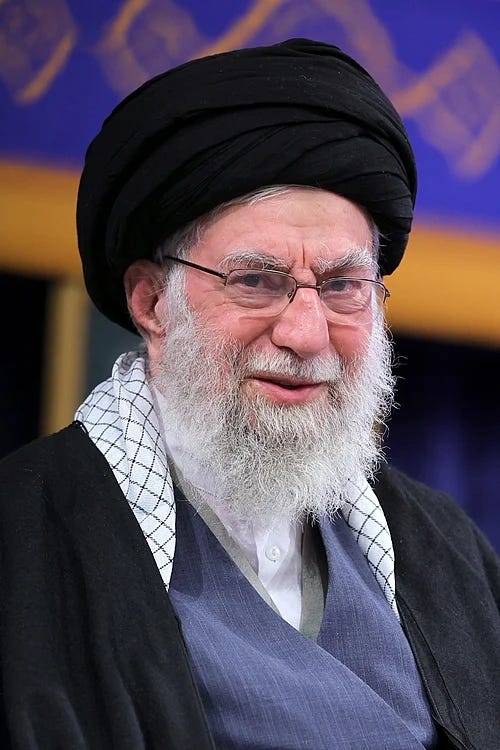
Iran was ruled by the Supreme Leader Ali Hoseini-Khamenei for decades, until he was killed by U.S./Israeli strikes. Was this lawful?
International law looks at a killing like this through three different rulebooks:
(1) Use of force: When countries can legally attack;
(2) Rules of warfare: How wars must be fought;
(3) Human rights law: Protections against unlawful killing.
Each protects something different: global peace (1), civilians in war (2), and the right to life (3).
Under the use of force: unlawful
The missile that killed Khamenei was itself a use of force.
As I explained in my last post, the U.S./Israeli strikes were not justified under international law.
Because the use of force was unlawful, so was the killing.
Under the rules of warfare: unlawful
In war, a leader who commands armed forces can be a lawful target. Khamenei was Iran’s Commander-in-Chief, so he could be targeted.
But even lawful targets must be attacked lawfully:
(i) Distinction: Don’t target civilians.
(ii) Proportionality: Civilian harm can’t be excessive.
(iii) Precautions: Minimise civilian harm.
Reports suggest the strikes damaged civilian sites, including a school. So even if hitting Khamenei may have been allowed, the way it was done likely violated the laws of war.
Under International human rights law: unlawful
Human rights law protects people from arbitrary killing (Article 6 ICCPR), in peace and war.
A state is responsible if its actions — like an airstrike — directly and foreseeably cause someone’s death, even abroad (UN report, at para. 63).
The (very strict!) exception: if the killing is strictly necessary to stop an immediate threat to life.
Some might argue Khamenei posed an immediate threat to Iranian civilians. But conditions must be met (UN report, at para. 12) — some are:
(i) Immediacy: The threat must be imminent. Ongoing repression over months counts as “ongoing harm,” not imminent (even if morally the distinction feels counterintuitive!).
(ii) Necessity: Killing must be the only way to protect life. The U.S. could have used ongoing nuclear deal negotiations to press Iran to stop repression, or capture him as he did Maduro.
(iii) Proportionality: The harm caused cannot exceed the threat. Killing Khamenei triggered large-scale conflict far beyond any danger to Iranian civilians.
Because these conditions aren’t all met, the strike would likely count as an illegal extrajudicial killing.
(If you have different views, I’d love to hear them in the comments!)
Conclusion: Unlawful
Killing Khamenei was not lawful under international law.
*NOTE: I acknowledge that many Iranian civilians suffered grievously under his regime for decades and have discussed it in a previous post. But this highlights a limitation of international law: it does not always provide effective enforcement tools to protect people. This must be remedied sooner rather than later.
Other SAIL posts you might enjoy:
The US-Israel-Iran War Has Been Ugly. Here’s What International Law Says (in 3 minutes)
The Strait of Hormuz: A 3-Minute International Law Breakdown
10 Days, 10 Issues: The International Law of the US-Israel-Iran War (in 3 minutes)
The U.S. and Israel Strike Iran: A 2-Minute International Law Breakdown
Mya be the approach adopted by Judge Cancado where he focuses on International law keeping peoples in mind rather than States can be a lens to look at Iran's treatment towards its civilian population.