


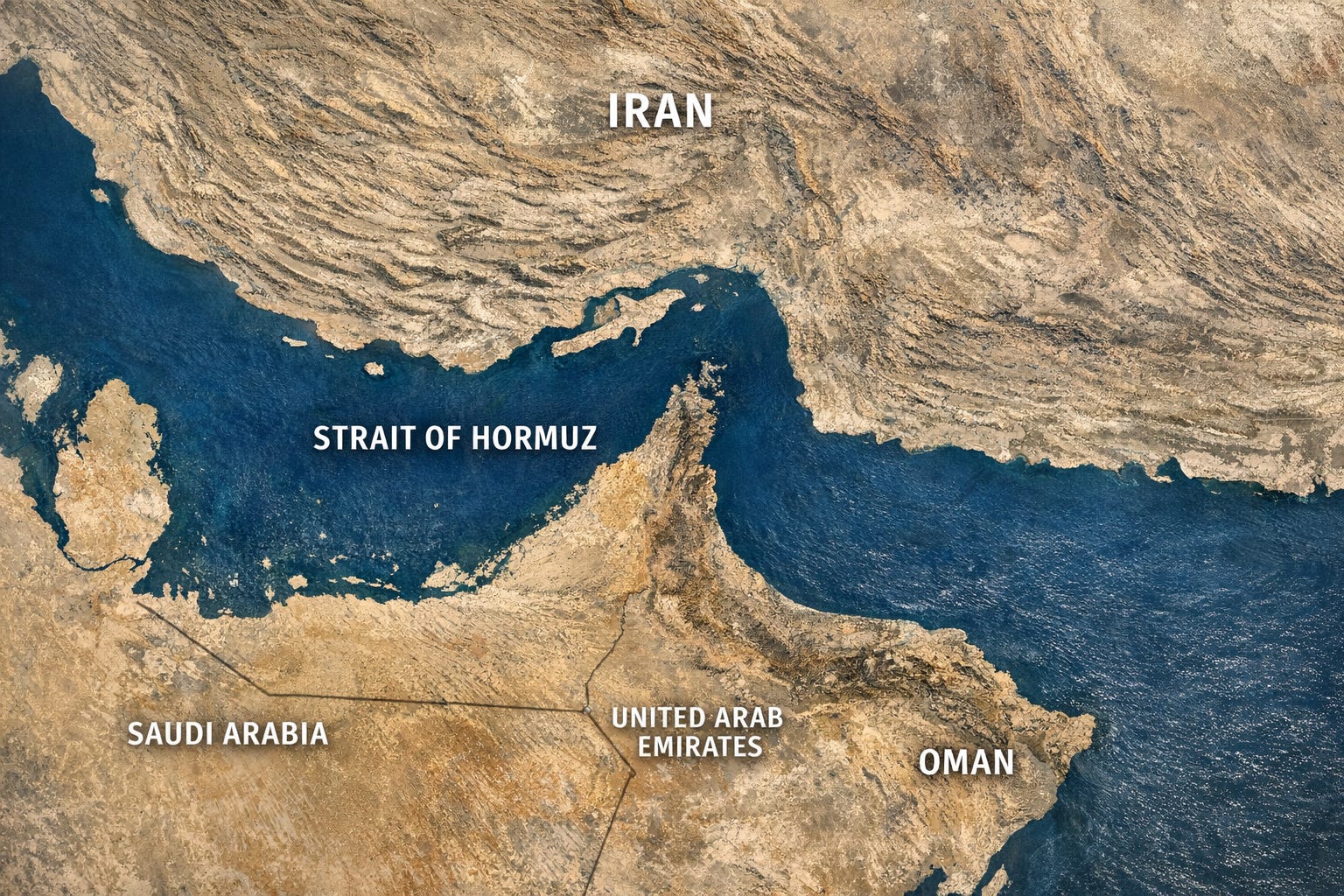
Following the U.S.-Israeli attack on Iran in February 2026, Iran has restricted the Strait of Hormuz, through which roughly 20% of the world’s oil passes.
Can Iran restrict the Strait of Hormuz?
Legally, no. But Iran has enough legal ambiguity to make life very difficult for ships that try to pass.
Most of the Strait sits within Iran’s territorial waters. What Iran can and can’t do with those waters is governed by the UN Convention on the Law of the Sea (UNCLOS) — but Iran isn’t a party to that.
Here’s the thing though. In international law, some rules are so widespread they become universal — binding on everyone, treaty or not. So the real question is: are the rules stopping Iran from closing the Strait universal ones?
That depends entirely on which rules we’re talking about — and this is where it gets interesting.
Geographically, the Strait of Hormuz is clearly what’s called a transit passage strait: it connects two open seas, has no alternative route, and is one of the busiest shipping lanes in the world. Under transit passage rules, other countries have an almost unrestricted right to sail and fly through. Iran can barely interfere at all.
So instead, Iran argues it’s an innocent passage strait (typically a dead-end strait or one with an alternative route) — which gives it significantly more control over who gets through and on what terms. The innocent passage rule is old enough to count as a universal rule, meaning it binds Iran whether it signed UNCLOS or not.
It’s a clever legal manoeuvre. Iran is essentially rejecting the rules that match the geographic reality of the Strait, and substituting older rules that happen to suit it better — rules that are harder to challenge precisely because they’re so well established.
The U.S. has long argued that Hormuz is a transit passage strait, and that transit passage rules have also become universal by now. But that second part is genuinely contested. So until it’s settled, Iran has just enough legal cover to keep making its argument.
So who’s right: Iran or the U.S.?
The U.S. is right about the geography (Hormuz is a transit passage strait). Iran is right about which rules are universal (innocent passage, not transit passage). But neither is being fully straight with you:
The U.S. is also not a party to UNCLOS.
So the U.S. is arguing that transit passage has become universal and binds Iran. But if that’s true, the same logic binds the U.S. too.
The US is essentially invoking a rulebook it also refused to sign, just to reach a different conclusion to Iran.
Iran’s allowing some countries‘ ships through and blocking others. Can it?
Not by nationality.
But under innocent passage, Iran can block individual ships it deems a security threat, which in practice amounts to much the same thing.
Is Iran’s ship attacks in the Strait legal self-defence against the US-Israel strikes?
Partly.
Iran was attacked first, so it has a legitimate self-defence claim against the U.S. and Israel.
But self-defence must be proportionate and directed at your attacker.
The moment Iran starts attacking neutral vessels from countries with no involvement in the conflict, it crosses from legitimate self-defence into unlawful conduct.
Are Iran’s attacks on ships legal under rules of warfare?
Iran can only lawfully target ships directly contributing to the enemy’s war effort, e.g.: a tanker carrying fuel specifically for the U.S. or Israeli military.
Everything else (e.g., neutral vessels, commercial ships, tankers carrying oil for civilian use regardless of destination) is off limits.
The media’s calling this a blockade. Is it?
No.
A blockade in international law has a specific meaning: the effective prevention of all vessels from accessing an enemy’s coastline.
‘Effective’ is the key word.
A legal blockade has to actually work. If ships are still getting through, it doesn’t qualify.
Without a valid blockade, Iran has no legal authority to stop and search neutral vessels.
Iran may have laid mines (i.e. planted underwater bombs in) the Strait of Hormuz. Can it legally do that?
No.
These are indiscriminate, i.e., they can’t tell a military vessel from a neutral tanker and just blow up whatever passes over them.
This violates the basic rules of warfare: you must be able to distinguish between military targets and civilian ones, take precautions to minimise civilian harm, and ensure the harm caused is proportionate to the military gain. Mines fail all three tests.
U.S. allies have rejected Trump’s call for help. Are they required to help the U.S. keep the Strait open?
Unlikely.
Other countries can only lawfully help the U.S. through collective self-defence: coming to the rescue of an ally under attack. But two things make that difficult here.
First, any U.S. self-defence rights only kick in after an 'armed attack' — and not every attack qualifies. The threshold is higher than it sounds, and Iran’s attacks on vessels may not clear it.
Second, self-defence is only available to the party that didn’t start the fight.
If Iran’s actions in the Strait are a response to the U.S.-Israel strikes, the U.S. can’t cleanly invoke self-defence… and any country joining it would risk being seen as part of the U.S.-Israeli continued aggression instead. No thanks.
If you found this useful, share it with someone who will find it useful too!
Other SAIL posts you might enjoy:
The US-Israel-Iran War Has Been Ugly. Here’s What International Law Says (in 3 minutes)
10 Days, 10 Issues: The International Law of the US-Israel-Iran War (in 3 minutes)
Was Killing Iran’s Supreme Leader Lawful Under International Law? (In 2 minutes)
The U.S. and Israel Strike Iran: A 2-Minute International Law Breakdown
Half & Half
I found this explanation extremely helpful. Why are you so concerned about creating an answer that only takes 3 minutes to read? You're helping me understand something, so take as much time as you need to correctly answer your question!