


For the first time in history, a country has been found to have committed genocide by the UN’s top court.
In a landmark judgment delivered today, the International Court of Justice (ICJ) declared that Myanmar committed genocide against the Rohingya, a mostly Muslim minority from Myanmar’s Rakhine State.
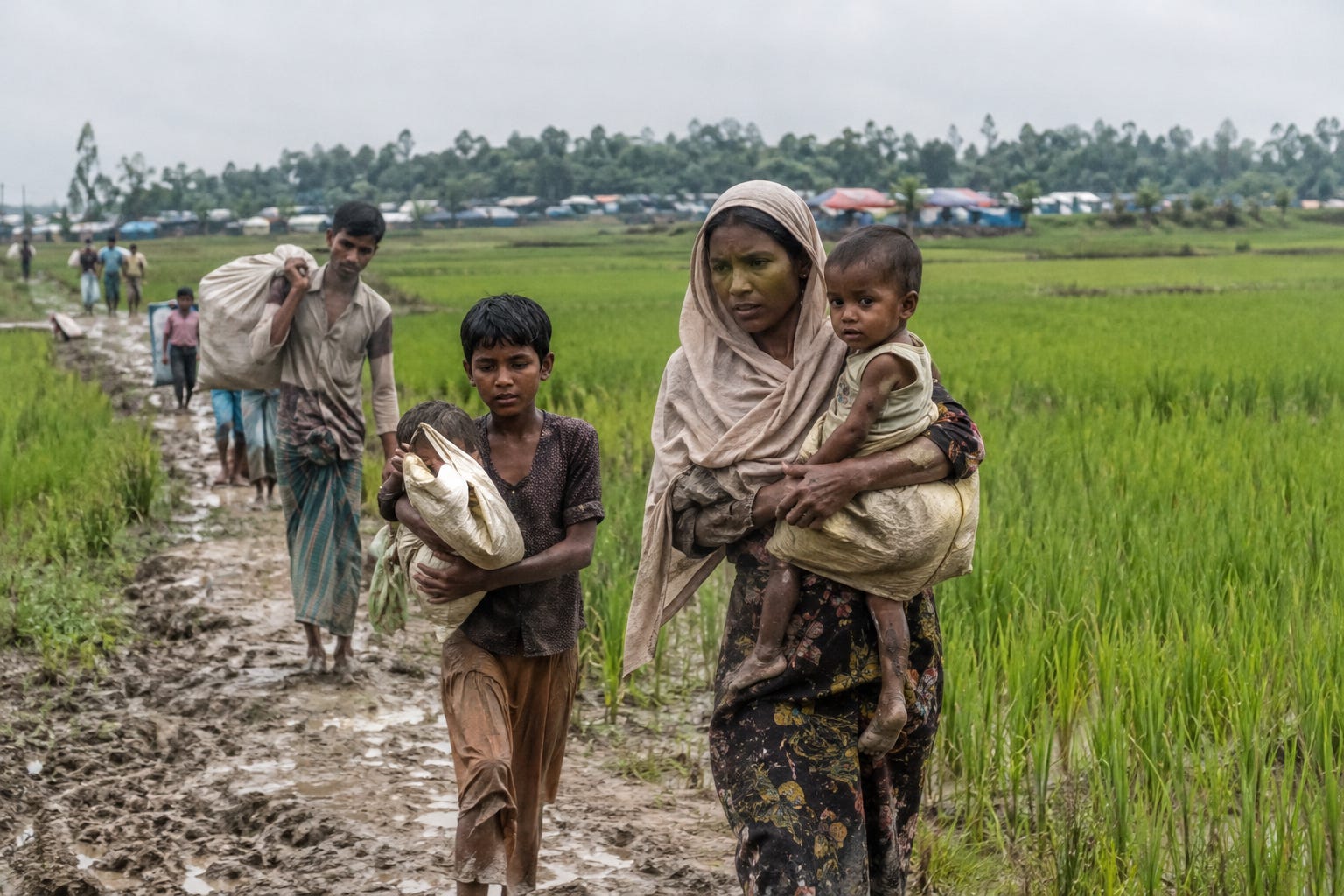
For decades they were persecuted. In August 2017, after an armed Rohingya group attacked police posts, the military launched “clearance operations” marked by mass killings, rape and the burning of villages.
More than 700,000 people fled to Bangladesh.
The Gambia then brought the case to the ICJ in 2019, saying Myanmar broke the Genocide Convention.
There are many ways a country can break it (e.g. committing genocide, conspiring to commit it, incite it, try to commit it, be complicit in it, fail to prevent it, fail to punish it, etc.), and the Court found Myanmar broke it in several ways.
But I’ll focus on the big one: actually committing genocide.
How did the Court reach its conclusion?
Genocide is defined in Article II of the Genocide Convention:
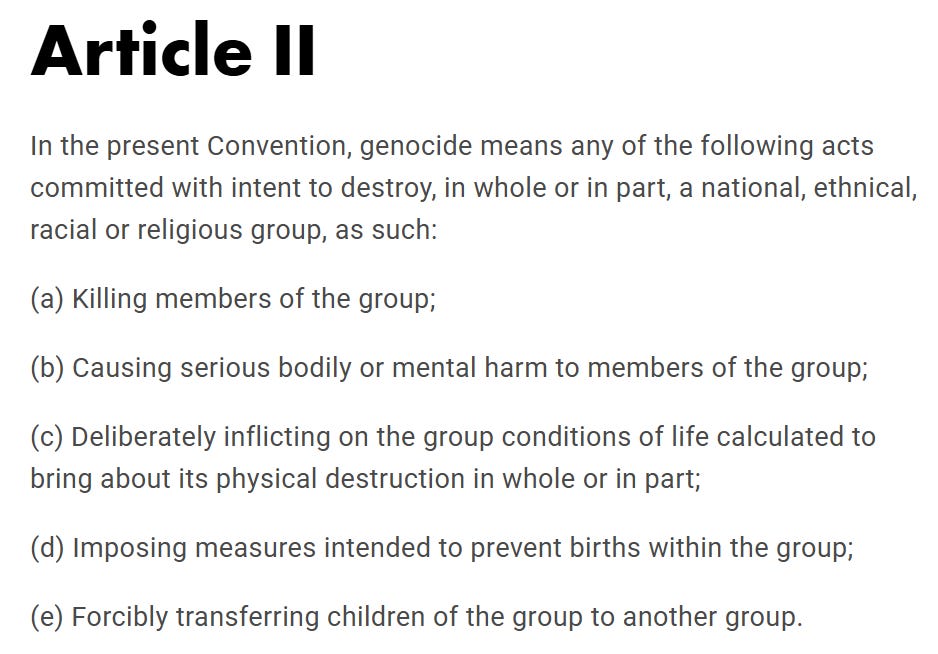
The Court went through all the elements of the definition to check they’re met:
Is there a national, ethnical, racial or religious group?
Yes, the Rohingya are a distinct ethnic group.
Did one of the five acts in Article II happen, and was it done intentionally?
Each act must be deliberate (not an accident or carelessness). This is called general intent: intent to do the act itself.
Genocide then needs a second layer: specific intent to destroy the group. (I’ll get to that in a moment.)
Example: a soldier who deliberately shoots civilians has general intent to kill. But that will only become genocide if the killing is also done with the specific intent to destroy the group.
The Court concluded that Myanmar’s killing (II.a), causing serious bodily or mental harm (II.b) and imposing measures to prevent births (II.d) happened with general intent (keep reading for the ‘specific intent’ assessment!).
Is the part of the targeted group big enough (“in whole or in part”)?
Yes.
The target doesn’t have to be the whole group, but it must be a substantial part of it.
What counts is how many people were targeted, not how many were killed.
About 815,000 Rohingya lived in northern Rakhine, the only region where they were a majority.
Was there specific intent to destroy the group?
What must the Court look for?
Myanmar didn’t make an explicit declaration (that hardly ever happens!), so the Court has to look at indirect clues.
The Court said it doesn’t need to find a “pattern of conduct” first. Intent can be inferred from a range of different factors, looking at all the evidence together.
Do the clues point to genocidal intent?
The Court looked at four factors to answer that question:
(a) General context: Yes. Decades of legal discrimination, anti-Rohingya hate speech, earlier military operations and forced displacement.
(b) Selective targeting: Yes. Only Rohingya villages were burned and razed, and non-Rohingya groups were then resettled in those areas.
(c) Acts attacking the foundations of the group: Yes. Widespread sexual violence and the targeting of children. The killing of children was hard to explain on any basis other than their being Rohingya.
(d) Systematic nature and scale: Yes. The operations were planned and organised, which suggests deliberation and purpose.
Is intent to destroy the *only* reasonable explanation?
You can have:
- (i) Genocidal intent alone. That’s just genocide.
- (ii) Genocidal intent alongside another aim, e.g. counterterrorism/ security/ punishment. The Court clarified here that this can still be genocide as the other co-existing aim doesn’t cancel genocide out.
- (iii) A different aim instead of genocidal intent, e.g., driving people out without wanting to destroy them. Only this third kind rules out genocide.
So the question is: does genocidal intent explain all the evidence taken together, and can any explanation of the third kind ((iii)) explain it too?
Myanmar offered three alternative explanations, and the Court rejected all of them because none of them explained all the evidence.
For counter-terrorism: Myanmar made no distinction between civilians and fighters.
For expulsion: that doesn’t explain the brutality, the attacks on people fleeing, or the attacks on young children.
For punishment: what Myanmar did went “well beyond” punishment.
So, the Court was “fully convinced” that the only reasonable explanation was an intent to destroy a substantial part of the Rohingya.
So did the Court “loosen” the test for genocide?
Many commentators predicted the Court would make genocide easier to prove. So did it?
Not quite.
The legal test stayed the same, but the majority of judges’ treatment of the evidence is a bit different.
In Bosnia v Serbia (2007), the Court found that genocide was committed at Srebrenica, but by Bosnian Serb forces whose acts couldn’t be attributed to Serbia. So Serbia was held responsible only for failing to prevent and punish it — not for committing it.
In Croatia v Serbia (2015), the Court found no genocide at all.
In this Myanmar case, the basic rule is the same: When there’s no direct proof, genocide must be the only reasonable explanation for what happened.
What was unclear before (in the Bosnia and Croatia cases): if a state had another aim, like fighting an armed group, did that automatically rule out genocide?
Many assumed yes, and that this was why Serbia was not found to have committed genocide.
But in today’s Myanmar judgment, the Court clarified: no.
As explained above, only a different aim instead of genocidal intent rules out genocide.
In the Bosnia and Croatia cases, there was evidence of organised transfers and evacuations: the aim was to drive people out, not destroy them. The exception was Srebrenica, where genocide was found.
In Myanmar, there was no evidence of any plan to move the Rohingya out, and soldiers attacked people even as they fled.
So, according to the majority, the outcomes differ because of different facts, not different law.
So, did the Court “loosen” the test? The majority says no: it just applied the same rule and answered a question that the earlier cases hadn’t faced.
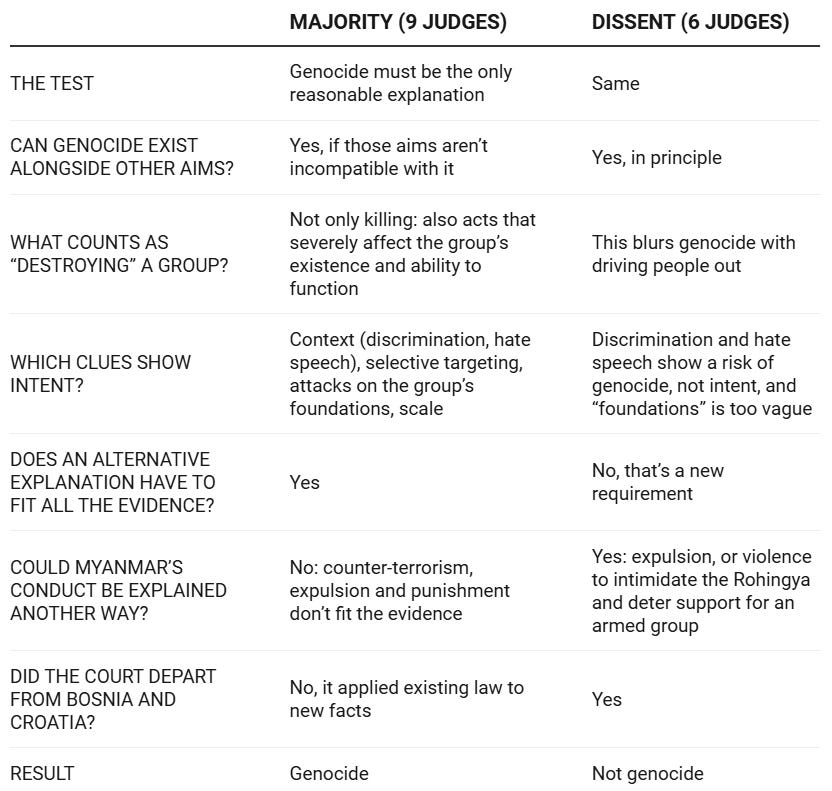
But 6 of the 15 judges did not agree.
Did all the judges agree that Myanmar committed genocide?
No.
9 voted in favour, and 6 voted against (That’s a huge split!): Vice-President Sebutinde, Judges Tomka, Abraham, Xue, Nolte, and Judge ad hoc Kress.
In a joint dissent, they say the majority departed from the Court’s earlier genocide cases (Bosnia and Croatia) and made it easier to prove genocide.
(Interestingly, four of them judged the Croatia case.)
They agreed some other aims can exist alongside genocidal intent. But their objection is on which clues show intent, and whether Myanmar’s alternative explanations have to fit all the evidence taken together.
To them, Myanmar’s violence could be explained as an effort to drive the Rohingya out or terrorise them into abandoning support for an armed group. So, genocide was not the only reasonable explanation.
One reason for the judges’ split is likely that in the Bosnia and Croatia cases, the ICJ relied on findings of the Yugoslavia war crimes tribunal. But here, it relied mainly on UN fact-finding reports and had to draw its own conclusions from the evidence, which left more room to disagree.
Summary table of the controversy (I love making these!):
(© SAIL, please ask for my permission before replicating this table)
What are the consequences?
Myanmar must fix ongoing breaches (i.e.: pass legislation giving effect to the Genocide Convention, and take immediate and effective steps to investigate, prosecute and punish those responsible for the 2017 clearance operations).
It must guarantee it won’t happen again.
It must repair the harm in several ways:
allow the safe, voluntary and dignified return of displaced Rohingya and reunite families;
return or replace all lost or damaged property;
help search for the disappeared and rebury the dead in accordance with Rohingya traditions;
provide physical and psychological rehabilitation; protect the Rohingya from discrimination and persecution, including in access to citizenship and freedom of movement.
Myanmar must also compensate the Rohingya for any damage that its repairs can’t make good, but the Court will decide the amount later.
The Court has no police force, but if Myanmar refuses to comply, The Gambia can take the matter to the UN Security Council. Though in practice, that’s unlikely to achieve much as Russia and China, both partners of Myanmar’s military government, hold vetoes.
Meanwhile, Myanmar has two years to report on what it has done to repair the harm, so the case is staying on the books.
What might this mean for Gaza?
This judgment is, first and foremost, a moment of justice for the Rohingya after years of suffering.
But I’ve received an enormous number of questions about what this judgment means for Gaza.
Subscribe to receive my next post, where I’ll get into that!
Thanks for this, I also just published an article on the topic - a very big and indeed important step in international law!
Potentially this will embolden opposition to the current government which could result in a more civilian style democracy for future Myanmar. One can dream🩵☮️🌈🌏