


[The usual caveats apply: this is a simplified explainer, lawyers disagree on several of these points, and by the time you read this, something may have already changed.]
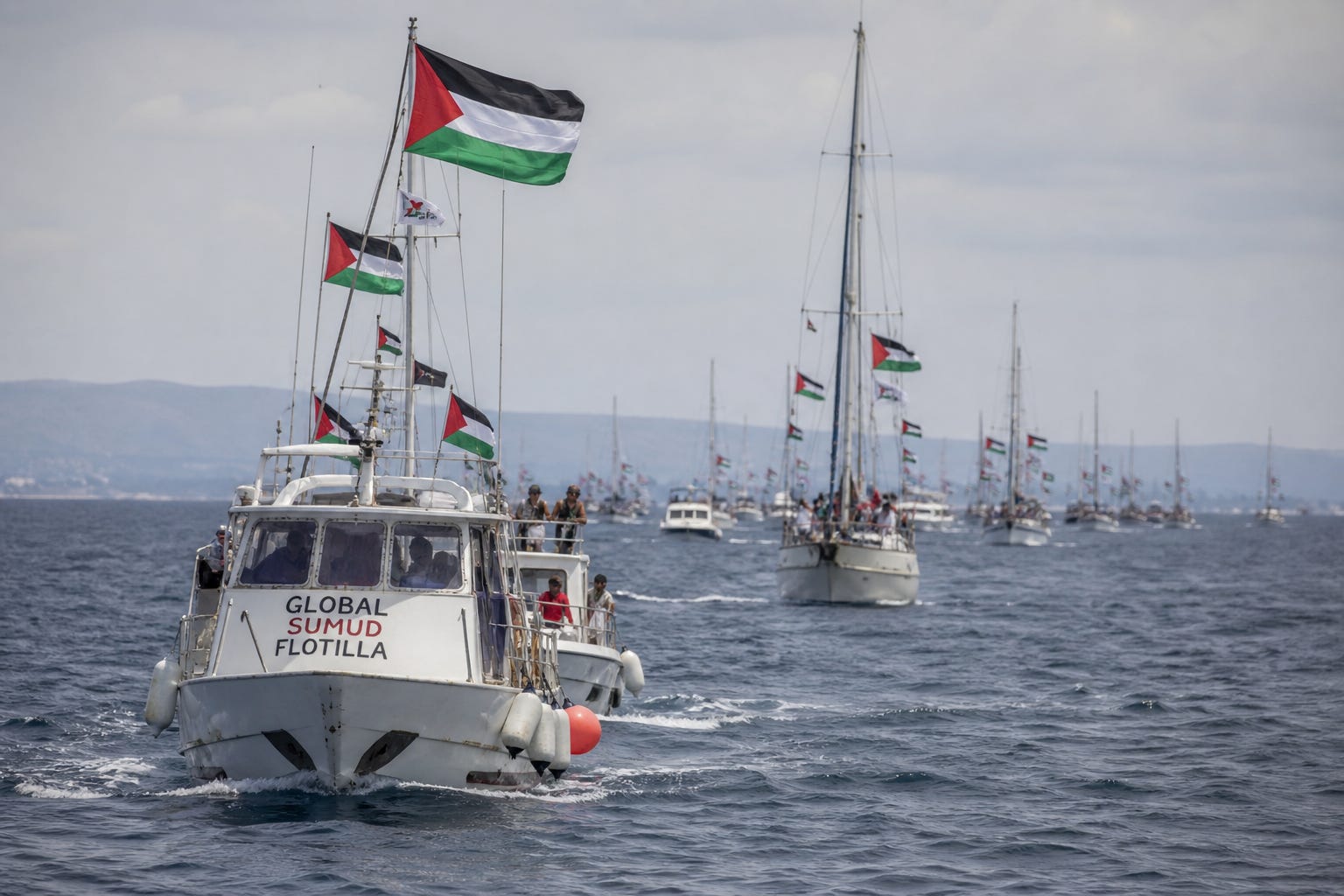
The Global Sumud Flotilla is a fleet of civilian ships carrying doctors, journalists, activists and politicians from 40+ countries, loaded with food, medicine and baby formula.
It has attempted multiple times to sail to Gaza and break Israel’s naval blockade, and has been intercepted (i.e. stopped, controlled, boarded, searched) by Israel every time (latest episode = April 2026.)
PART 1: WAS ISRAEL ALLOWED TO STOP THE FLOTILLA?
Not under the UN Convention on the Law of the Sea (UNCLOS).
UNCLOS says that no country can board another country’s ship without permission once you’re beyond a country’s coastal waters.
That rule applies whether you’re in the open ocean or, as here, in the waters near Crete.
Israel isn’t a party to UNCLOS, but that rule is so universally practiced and accepted that it binds every country whether they’ve signed the treaty or not.
The Flotilla ships had national flags indicating they belonged to those countries (e.g., Spain, France and Italy) who were furious. Many called it an act of piracy. (Legally, piracy usually involves private actors, not state militaries, so that label is contested.)
But Israel would argue we’re looking at the wrong rulebook. UNCLOS doesn’t apply at all and wartime naval law takes over entirely, because it’s at war with Hamas and running a legal naval blockade of Gaza.
So the question is, under wartime naval law: is there actually a legal blockade? (PART 2) And even if it is… did it handle the flotilla lawfully? (PART 3) Let’s go!
PART 2: IS ISRAEL’S BLOCKADE OF GAZA LEGAL?
A naval blockade is a military operation that stops ships from reaching a coastline.
The logic is simple: if you’re at war with someone, you can cut off their supply lines by sea.
To assess if the blockade is legal, there are two questions: Did Israel have the legal right to impose a blockade to begin with? And even if yes, is it running the blockade legally?
Did Israel have the right to impose a blockade?
This is disputed.
Blocking Gaza’s coast is using force under international law.
The only two things that can make this use of force legal are UN Security Council approval or self-defence.
The Security Council didn’t sign off on Israel’s blockade, but Israel says it’s acting in self-defense against Hamas’ October 7 and years of prior attacks.
It’s supported by one 2011 UN report saying the blockade is ‘a legitimate security measure to prevent weapons entering Gaza’.
The catch: the International Court of Justice (ICJ) said you can’t be both the occupier and claim you’re defending yourself against the people you’re occupying… and also said Gaza is occupied Palestinian territory. That contradiction is Israel’s core problem.
Even if yes, is Israel running the blockade legally?
Unlikely.
A legally-run blockade must meet five conditions: publicly declared, consistently enforced to all ships, during an inter-state war, must not starve civilians, and must allow humanitarian aid through. Miss any one and it’s illegal. The first two aren’t the main controversy. The last three are tricky for Israel.
During an inter-state war:
The 2011 UN report says Hamas functions enough like a state to trigger the laws of inter-state war. Critics reject this argument. They also say Gaza is illegally occupied by Israel and you can’t be at war with/blockade territory you occupy. No inter-state war = no blockade.
Must not starve civilians:
The UN, World Health Organization, Amnesty International and others have all said Gaza’s civilian population has faced famine conditions as a direct result of the blockade.
Starvation as a war crime is being investigated by the International Criminal Court and the UN and EU say the blockade is collective punishment (a war crime). It also feeds directly into the genocide case South Africa has brought against Israel.
Israel says the famine is fake news.
Must allow humanitarian aid through:
Israel says the flotilla was a Hamas operation, there was no humanitarian gap justifying it, and it was actually carrying drugs and condoms.
The UN Security Council and the ICJ have told Israel to stop blocking humanitarian aid.
PART 3: DID ISRAEL LAWFULLY INTERCEPT THE FLOTILLA UNDER WARTIME NAVAL LAW?
We established in Part 1 that under UNCLOS, Israel had no right to intercept the flotilla. But even accepting the argument that wartime naval law applies instead, the conclusion’s… probably the same.
First off, under wartime naval law, if there’s no legal blockade then any interception of the flotilla is unlawful. Full stop. If that’s your position, you can stop reading and mosey on with your day (hit that ‘Like’ button first, though! 😄)
But even a legal blockade doesn’t give Israel a blank cheque! It still has to intercept correctly. That means no intercepting humanitarian ships, no harming people onboard, humane treatment of anyone detained and no intercepting from an unreasonable distance.
No intercepting humanitarian ships:
You can stop ships trying to breach your blockade, unless they’re on a humanitarian mission, in which case they’re completely exempt and can’t be touched. Israel says it isn’t humanitarian, others disagree.
No harming people onboard:
Israel says the operation was conducted peacefully and without casualties. But activists reported being subjected to extreme brutality.
Humane treatment of anyone detained:
Detainees reported Israel was violent and treated them badly. Israel says detainees were unharmed.
No intercepting from an unreasonable distance:
The law doesn’t clearly say what the appropriate distance is, but the 2011 UN report said the 2010 Mavi Marmara interception was 72 miles/133 km too far, while the 2026 interception happened at 600 miles/1111 km!
But Israel says the size of the flotilla (over 100 vessels) justified early interception for safety and security reasons.
More generally Israel also has to follow basic wartime rules like proportionality (meaning the military benefit of stopping the flotilla has to outweigh the harm caused, especially to civilians). Based on the facts, hard to say this was proportionate… but what do you think?
In brief, my friends:
UNCLOS says no → flotilla interception already unlawful.
Wartime naval law applies → but legality of blockade is contested.
If blockade is legal → must still follow interception rules but likely didn’t → unlawful.
If you found this useful, share it with someone who might find it useful too!
If you enjoyed this SAIL post, you might also enjoy:
The US-Israel-Iran War Has Been Ugly. Here's What International Law Says (in 3 minutes)
Israel’s Occupation of Southern Lebanon: A 3-Minute International Law Breakdown
Five Reasons the US-Iran Ceasefire Is Legally Fragile (in 3 minutes)
The Strait of Hormuz II: Answering Your International Law Questions in 3 Minutes
In case readers are interested, I’ve just created a user-friendly guide to the rules of war and intl law (downloadable): https://shalyn8.substack.com/p/understanding-the-rules-of-war-a
I think you missed one important part. San Remo Manual on International Law Applicable to Armed Conflicts at Sea, articles 93, 94:
"93. A blockade shall be declared and notified to all belligerents and neutral States.
94. The declaration shall specify the commencement, duration, location, and extent of the blockade and the period within which vessels of neutral States may leave the blockaded coastline."
A blockade has a location, it's not... global. By intercepting ships west of.. Crete Israel is in clear violation of the rule to execute a blockade in a specific location.