

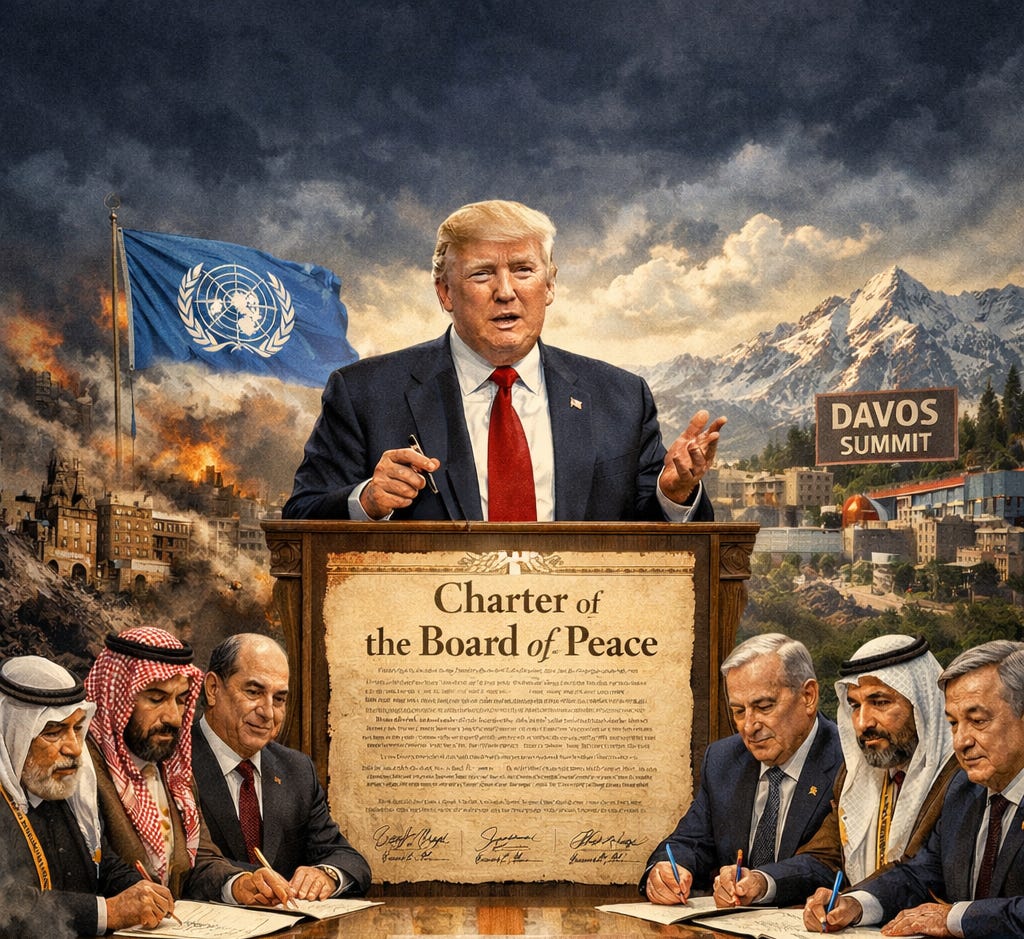
After the Israel–Hamas ceasefire, Trump unveiled a peace plan backed by the UN Security Council, setting up a Board of Peace (BoP) to rebuild and stabilise Gaza.
This week, Trump rolled out the BoP’s Charter along with invitations for leaders to join by signing it at Davos this week.
But on closer look, it has some serious international law problems.
The BoP is not an international organisation
The Charter calls the BoP an international organisation.
It (sort of) looks like one too: it has members, voting rules, membership fees, and even claims its own legal personality.
But calling something an international organisation doesn’t magically make it one.
What actually matters is how it was set up.
True international organisations are built by treaties signed by countries, meaning they collectively agree to give it power and legitimacy.
The BoP, by contrast, was created by a UN Security Council resolution.
That’s why it can’t claim the independence or authority of a genuine international organisation.
In UN practice (here, Article 29), the Security Council can create subsidiary organs (committees, tribunals, or temporary missions), but these are not independent international organisations.
The BoP fits this pattern: it is described by the Council as a ‘temporary administration’, not a treaty-based organisation of states.
The Charter goes beyond its Gaza mandate
The Charter wants the BoP to operate ‘in areas affected or threatened by conflict’… and it doesn’t mention Gaza once!
But because the BoP was created by a Security Council resolution, it exists to carry out that resolution’s objectives.
Its authority is delegated, not original. It can’t redefine or expand its role.
Acting outside its Gaza mandate (ultra vires) would be unlawful.
The Charter says the BoP is “forever” while it’s actually temporary
The Charter says the BoP can shut itself down whenever the Chairman feels like it, or every other year, unless the Chairman decides to keep it going.
But the Security Council Resolution clearly says the BoP only runs until the end of 2027, and any future action must be coordinated with Egypt, Israel, and the other involved states.
A subsidiary body can’t ignore or change the rules set by the Security Council when it was created.
It’s not even a realistic pretend-international organisation
Never mind that it’s not legally an international organisation — it has three unusual features no real international organisation would have anyway:
First, only States invited by the Chairman can join, giving one person total control and undermining its legitimacy.
Second, members can bypass rules by paying $1 billion (!), a highly unusual and unfair system.
Third, the BoP is extremely centralised, with Trump as lifetime chair and no independent oversight or rotating leadership.
The BoP imposes authority on Palestinians
No Palestinians sit on the BoP.
They are only on the National Committee for the Administration of Gaza (NCAG), which the Board supervises to run day-to-day services.
That means Palestinians are essentially being managed from above, not included in decision-making at the top.
This setup undermines Palestinian self-determination: the right to fully determine their own future.
Takeaway: The Security Council needs to rein in the BoP and fix its credibility problem. Like this post if you agree!
Other SAIL posts you might enjoy:
The US-Israel-Iran War Has Been Ugly. Here's What International Law Says (in 3 minutes)
Israel’s Occupation of Southern Lebanon: A 3-Minute International Law Breakdown
Five Reasons the US-Iran Ceasefire Is Legally Fragile (in 3 minutes)
The Strait of Hormuz II: Answering Your International Law Questions in 3 Minutes
Israel Stopping the Global Sumud Flotilla: An International Law Breakdown (in 4 minutes)