


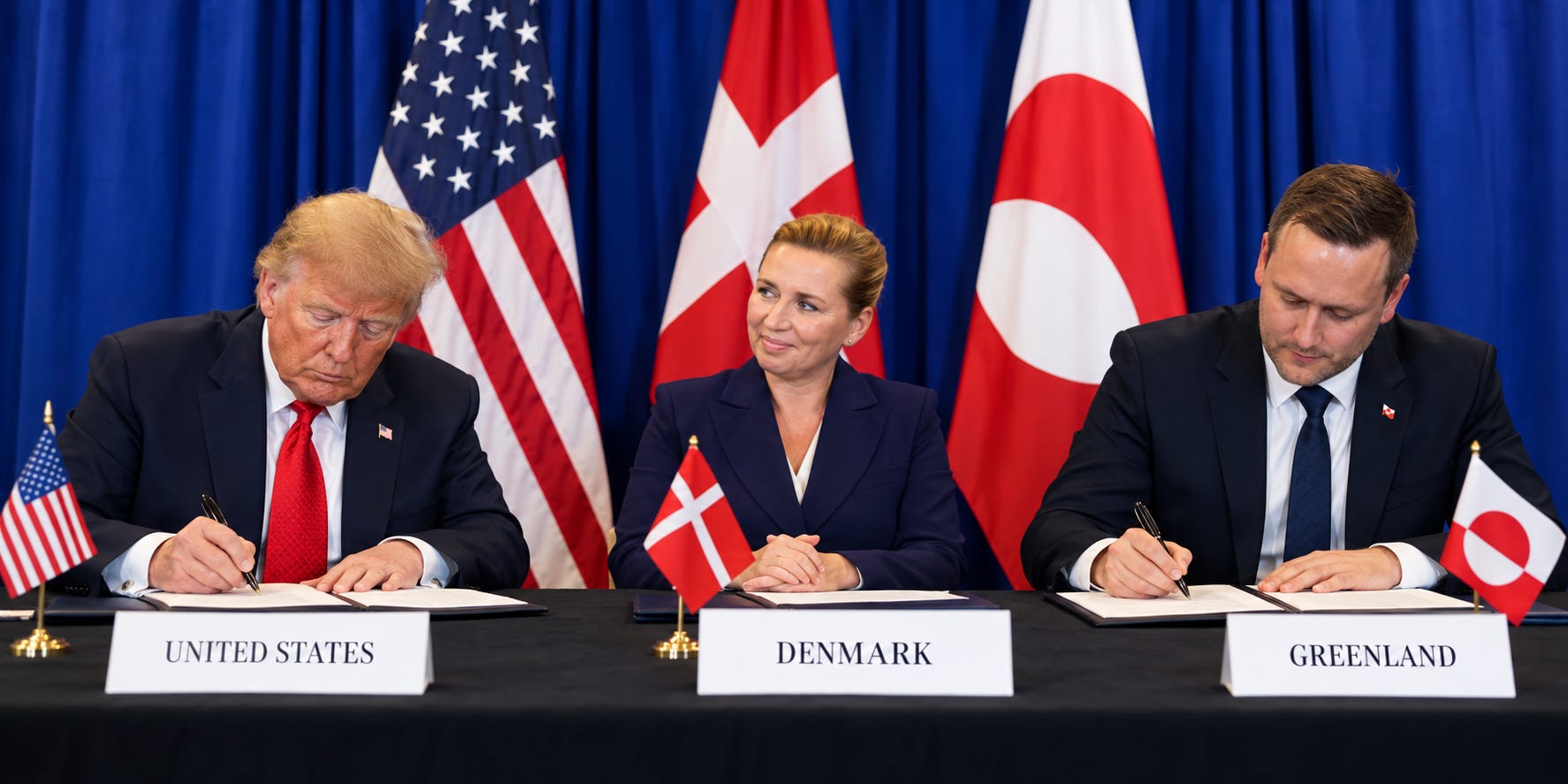
Trump has been gunning for sovereignty over Greenland since his first term of U.S. presidency.
Now, he made a deal with Denmark and Greenland.
The big surprise to me is that it is largely respectful of international law.
No plans to annex or take Greenland from Denmark. No ignoring the people of Greenland. It doesn’t even seem like Denmark/Greenland were coerced into the terms of this agreement; they’re happy with the outcome.
Here’s a quick take on what it says and means.
1. What does it say?
Basically: the U.S. gets more military room and can keep rivals (Russia, China) out, Denmark keeps sovereignty, and Greenland keeps its right to decide its own future.
The U.S. currently has one active military base in Greenland. This 2026 agreement allows it to expand it, plus build two more.
It can ask for even more than this, but Denmark and Greenland must agree.
U.S. planes can fly over and land anywhere on Greenland, and U.S. ships and submarines through its waters.
Countries outside NATO (China and Russia) can’t put military bases in Greenland or invest in sensitive areas (e.g., mining, ports, power).
The U.S. should give work building and running the bases to Greenlandic companies where possible, and respect local life (e.g., hunting, fishing).
Plus, the deal lasts indefinitely. If Greenland becomes independent one day, Denmark and Greenland promise that it will stay in NATO and keep this deal.
2. What are the differences with the 1951 Agreement?
This deal is very similar to the 1951 Defense Agreement the U.S. and Denmark already had. It even says it’s amending and adding to it.
What has stayed the same:
The U.S. bases only exist where both sides agree
The U.S. has freedom of movement by land, sea and air
Denmark keeps sovereignty over Greenland, and
Any changes happen by mutual consent.
What this agreement has changed:
It’s permanent
It adds two U.S. bases
It bans military bases of non-NATO states (Russia/China)
It involves Greenland as a party and acknowledges the Greenlandic peoples’ rights.
3. Trump said the deal “gives the U.S. permanent control over security, and all other needs, in Greenland”. Is that true?
Sort of.
“Permanent” is accurate.
“Control over security” overstates it. It can stop China/Russia from setting up a base. But security is shared, the U.S. needs Denmark and Greenland’s consent to do anything, and Greenland still belongs to Denmark.
Also, “all other needs” don’t seem to be covered in the agreement.
4. But there’s one concern…
It’s great that Greenlanders and their rights are acknowledged.
But I’m slightly concerned about their right to self-determination.
That’s essentially the right of a people to decide their own future.
The agreement does recognise it. But…
First, the U.S. gets a consultative role over who can extract Greenland’s resources. Greenland agreed to this, but technically the right to self-determination means Greenlanders have permanent control over their own resources without anyone else interfering.
Second, they’ve already agreed that if Greenland becomes independent one day, it will join NATO and this deal will continue to exist.
But isn’t the whole point of self-determination giving the people the right to decide if they want to be part of NATO or not?
If they become independent and change their mind at that point, they should be free to do so.
Technically, a new state (i.e. a future independent State of Greenland) isn’t bound by treaties made while it was part of another state. Some treaties do carry over, but foreign military base agreements are specifically excluded (Article 12(3)).
But Denmark and Greenland have promised to make it happen, so staying in the deal could become a condition of independence one day.
That might or might not be a problem the day Greenland takes the leap towards independence — only time will tell.
If you enjoyed this SAIL post, you might also enjoy…