


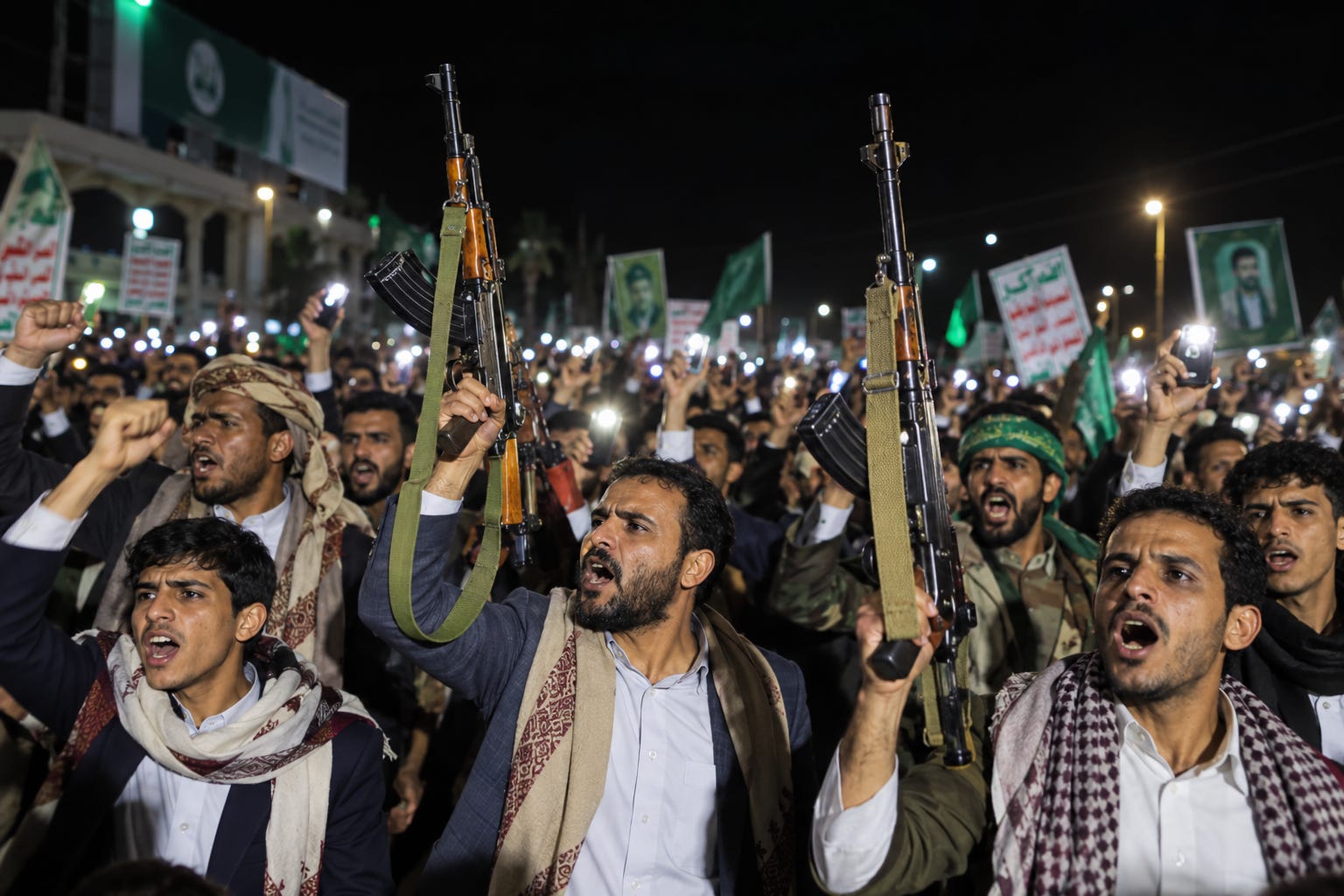
The Houthis are an armed movement based in Yemen.
Their number one goal is to overthrow the Yemeni government and rule the country. To that end, there’s been a civil war since 2014.
Another key goal is to support the Palestinian cause, and defy the U.S./Israel.
They are politically aligned with Iran.
Saudi Arabia – a fierce regional rival of Iran – has been in conflict with the Houthis since 2015, mainly as it fears a Houthi-controlled Yemen would act as a satellite state for Iran.
Yemen’s civil war had been largely frozen since a 2022 truce.
But in September 2026, the Houthis seized Yemen’s entire Red Sea coast, including islands inside the Bab el-Mandeb strait.
This triggered missile exchanges with Saudi Arabia that reached Riyadh and displaced some 100,000 people.
Here are your international law questions answered.
1. The Houthis declared a maritime blockade of Saudi Arabia. Is that legal?
No.
The rules for war at sea (including blockades) were built for wars between states, so it’s unclear whether it would apply to an armed group like the Houthis to begin with.
Even if we said it did, a legally-run blockade must also be consistently enforced to all ships – but the Houthis are only blocking Saudi-linked ships, letting others pass.
And if you still really want to insist this was a lawful blockade, this still doesn’t mean the Houthis can attack Saudi ships (as they have been). In a lawful blockade, ships are captured and only attacked after warning if they resist capture (Article 98). But the Houthis didn’t try to capture any ships at all.
2. Can anyone legally close the Bab el-Mandeb strait?
No.
Under the law of the sea, ships enjoy a right to pass in transit (Article 38), and that right can’t be suspended – even by the coastal state (and the Houthis aren’t even the recognised government of that coastal state!).
Even in wartime, straits are to be kept open to neutral shipping.
(Yemen has now taken the strait back from the Houthis, by the way.)
3. Do the Houthis have to follow any laws on war?
Yes.
Basic rules: treat civilians humanely, separate them from combatants and take precautions, attack if necessary and proportionately.
4. So is firing missiles at cities (like Riyadh) ever allowed?
Only at military targets, and only with weapons that can actually be aimed at them.
Yet civilians have been wounded and killed.
5. What about bridges, airports and refineries?
These are “dual-use”: civilians rely on them, but armies can too.
Such sites can only be hit if they are military objectives, and the expected civilian harm must not be excessive.
Saudi jets struck Al-Dalil Bridge in Ibb on 26 September. Houthi attacks have damaged the Jizan refinery and hit two Saudi airports.
6. Can one side hit back “in retaliation”?
Not by breaking the rules.
A violation by one side never licenses one by the other.
7. Is the US responsible for strikes it helps plan?
Possibly.
Over 100 US military advisers are reportedly giving Saudi Arabia intelligence and targeting support.
States must “ensure respect” for the rules of warfare. A state that knowingly helps another break international law can share responsibility.
8. Who will investigate any of this?
Right now, no independent investigative body.
The UN’s only investigative body on Yemen was shut down in 2021, apparently after Saudi-led lobbying.
Neither Yemen nor Saudi Arabia is a party to the International Criminal Court.
Earlier 2024 attacks on ships flagged to ICC member states (e.g., Belize, Liberia), could fall within its reach, though.
Domestic courts in other countries, hearing challenges to arms sales to Saudi Arabia (e.g., UK, France, Belgium), are where most of the action has been.
A regional player like Oman could mediate, but a peace deal could bring amnesties as easily as accountability.
Stay tuned.
If you enjoyed this SAIL post, you might also enjoy: