

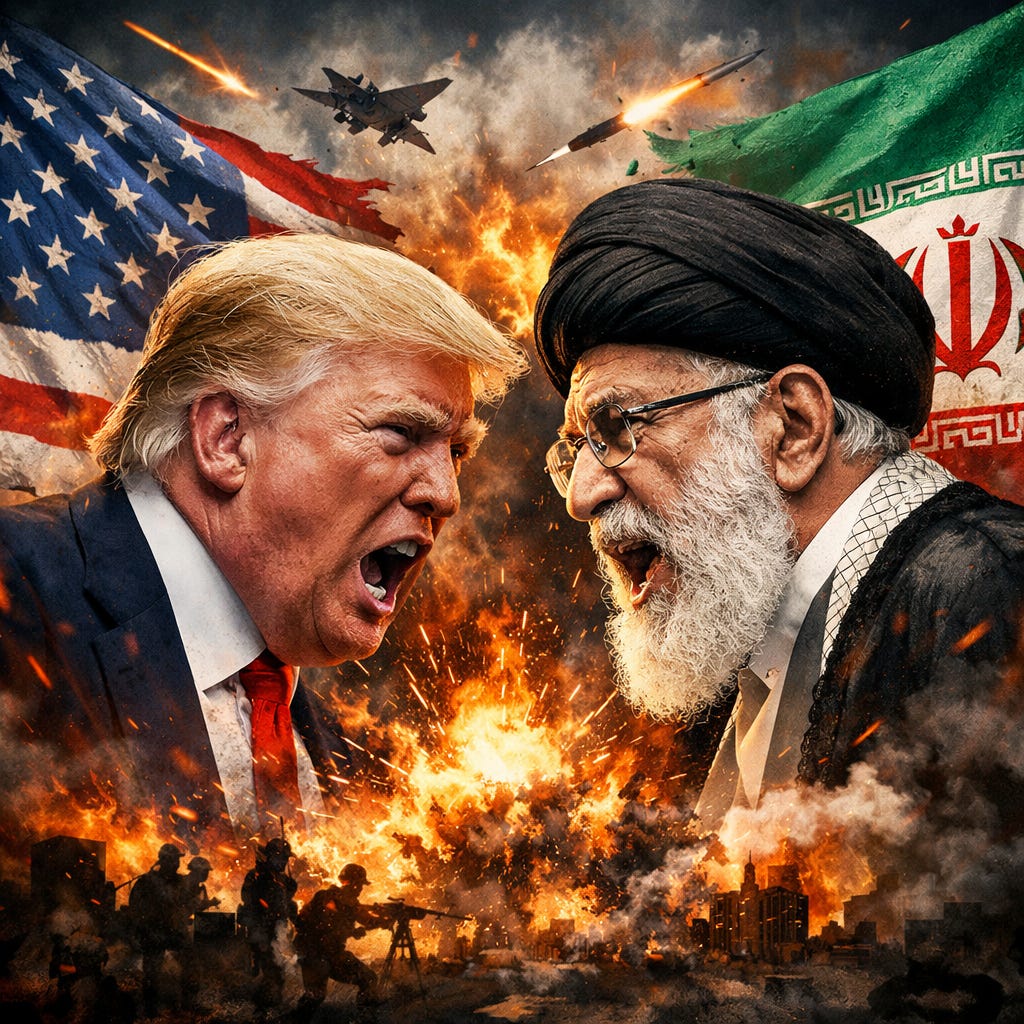
The U.S. says it may strike Iran if nuclear talks fail.
Here are your top questions answered:
Can the U.S. strike Iran?
No.
Attacking Iran without UN Security Council authorisation would be unlawful.
“Humanitarian intervention” (attacking to protect Iran’s population) is not an accepted legal basis.
Force is lawful in self-defense only if Iran is imminently attacking the U.S.
That does not appear to be the case here, as the U.S. would be initiating force.
Why might the U.S. strike Iran?
For years, the U.S., UN, and Western states have sanctioned Iran over its nuclear program.
In 2015, Obama helped negotiate the Iran nuclear deal (JCPOA), limiting Iran’s nuclear program in exchange for sanctions relief.
But in 2018, Trump withdrew the U.S. from the deal, calling it “insane”.
In 2025, fearing Iran might develop nuclear weapons, Israel and the U.S. coordinated strikes on Iranian nuclear sites.
In 2026, the logic is the same: preventing Iran from going nuclear.
Is Iran allowed to have a nuclear program under international law?
Yes, for peaceful use.
Iran is party to the Nuclear Non-Proliferation Treaty (NPT). The NPT allows non-nuclear-weapon states to develop nuclear energy for peaceful use (e.g., energy, medicine) but prohibits nuclear weapons.
Iran enriches uranium (used for bombs) up to 60%, below weapons-grade but close.
The International Atomic Energy Agency (IAEA) (the UN’s nuclear watchdog) has called this concerning.
Iran says Article 4 of the NPT lets it enrich uranium, so long as IAEA inspections can verify it’s for peaceful use.
Is Iran’s program for peaceful use?
Unclear.
Iran limited IAEA inspections in 2025, preventing full verification.
Iran maintains its program is peaceful and accuses the IAEA of bias.
Is Iran allowed to have nuclear weapons?
No.
Under the NPT, only five states are recognised nuclear powers: the U.S., Russia, China, France, and the UK — and even they are expected to pursue disarmament.
The NPT has 191 members. All others, including Iran, agreed not to build nuclear weapons.
(The 2017 Treaty on the Prohibition of Nuclear Weapons bans nukes entirely, by the way, but only 74 states have joined… and none of the five recognised nuclear powers (surprise!)).
Why does the U.S. care?
Security and history.
The U.S. and Iran were allies until the 1979 Islamic Revolution, when the Khamenei government rejected U.S. influence.
Iranian students seized the U.S. Embassy in Tehran, holding diplomats hostage for 444 days.
The U.S. sued and won a case against Iran at the International Court of Justice, and a claims tribunal in The Hague still handles disputes from that period.
With all this bad blood, the U.S. fears a nuclear-armed Iran would spell serious trouble.
Are the current Iran protests relevant?
Yes.
Iran’s protester crackdown and U.S. support for protesters heightened tensions.
Can Iran strike back?
Yes. (And it said it will!)
Under international law, a state may use force in self-defense in response to an attack.
But its response must be temporary (pending UN Security Council involvement), necessary to stop further harm, and proportionate (not excessive).
We’re almost at 1,000 SAIL readers; thank you! If you like SAIL, share it!
Other SAIL posts you might enjoy:
Israel Stopping the Global Sumud Flotilla: An International Law Breakdown (in 4 minutes)
The Strait of Hormuz II: Answering Your International Law Questions in 3 Minutes
Five Reasons the US-Iran Ceasefire Is Legally Fragile (in 3 minutes)
Israel’s Occupation of Southern Lebanon: A 3-Minute International Law Breakdown
The US-Israel-Iran War Has Been Ugly. Here's What International Law Says (in 3 minutes)
The USA/Isreal attack against Iran is not in self-defense. It’s an invasion of once sovereign rights systematically, violating an international law, under the failure of an international community.
The absence of consultation with the United Nations Security Council, combined with the lack of an initial attack by Iran against the United States or Israel, raises important legal and diplomatic concerns. Such actions may indicate a changing strategic posture in the Middle East during the administration of Donald Trump. It is essential for the international community to respond in a fair, balanced, and principled manner, upholding the UN Charter and reinforcing the rules-based international order in both the Middle East and Latin America.
You could have mentioned that most of Iran's dispute with US arises under the Treaty on Friendship, Commerce and Navigation between the two.