



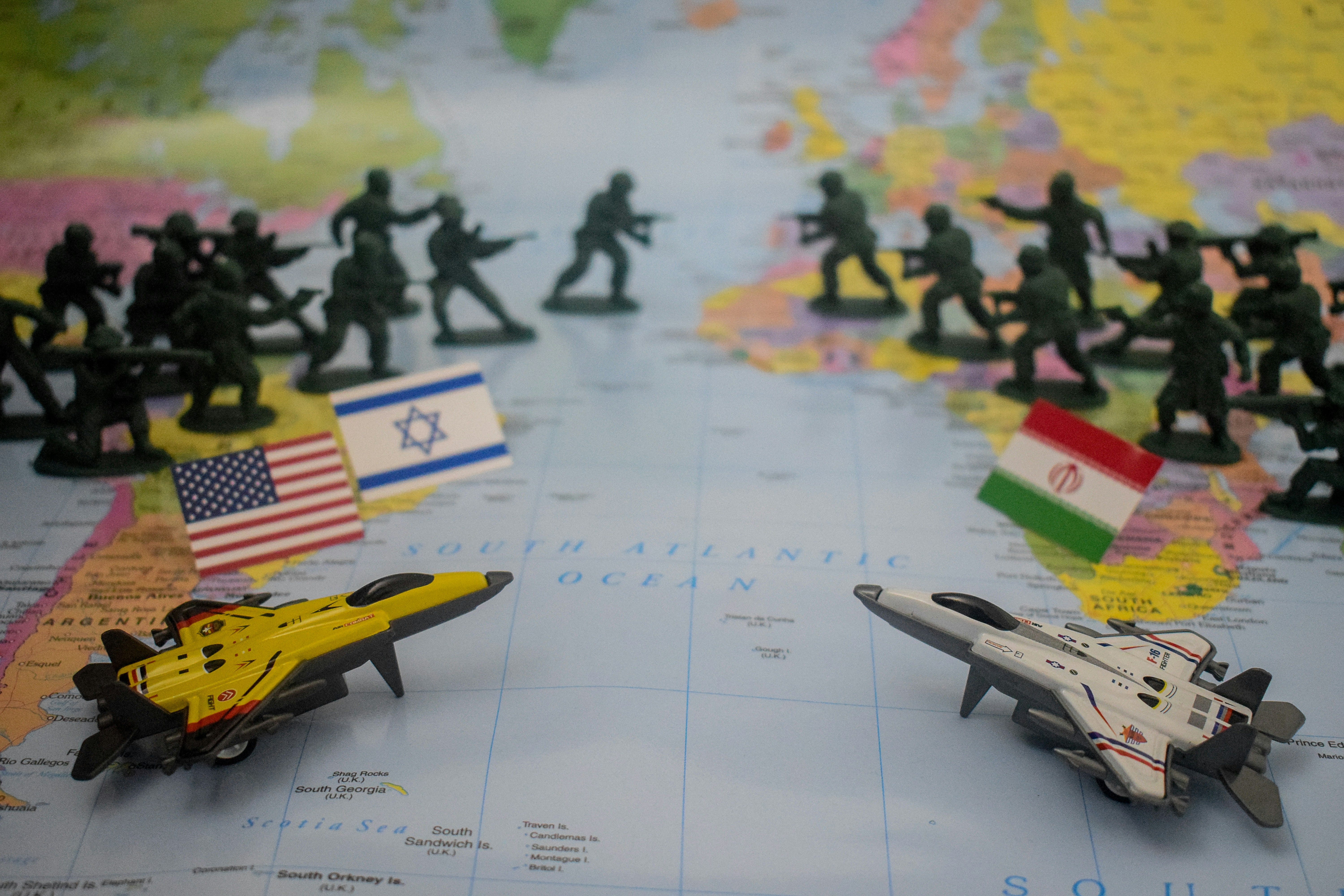
7 questions:
1. Why does every Iran ceasefire seem to fall apart within weeks?
Yusra:
Under international law, a ceasefire is only as strong as the instrument creating it, and the deals haven’t met the standard:
An earlier version had no agreed written text, and the latest version left the hardest legal questions (Hormuz, enrichment) unresolved.
To top it off, no enforcement: the latest deal was going to set up a system to ensure everyone follows the deal but never did.
Pascal:
A ceasefire agreement is not a peace treaty and even those are only as strong as the will of the states that enter them.
The UN Charter is in effect a global peace treaty that mandates peace on all. The USA and Israel have already broken the Charter when attacking Iran in the first place, as they have done in other armed conflicts, and they continue using diplomacy as a ruse to lull the other side into complacency.
Hence, their ceasefire agreements keep breaking because they want to break them.
2. Can Iran close the Strait of Hormuz and get away with it?
Pascal:
Yes.
The Strait of Hormuz is only around 33-39 kilometres wide at its most narrow point. This is well in range of the missiles and drones Iran produces.
Hence, Iran has the physical capability to damage or sink any ship that wants to go through, which gives it effective leverage if it chooses to do so.
Until February 2026, they did not do that, now since the war started, they do to gain leverage over the USA.
Yusra:
The Strait of Hormuz should be freely open to all ships under international law.
But Iran rejects the specific rules that say so, insisting a different legal framework applies that gives it far more power to restrict who passes through.
3. Why hasn’t international pressure worked?
Pascal:
The greatest pressure on a state is war.
And the USA and Iran are already in a war, so there is little pressure from the outside that could add to this and hurt them even more than the war itself does.
Outside pressure is structurally less important than prevailing in the war. Hence, the parties react much less to foreign pressure than to the hurt each one inflicts on the other.
Yusra:
International pressure got the parties to the table, but not through the hardest conversations on outstanding legal points in the ceasefire deal.
What’s missing is a combination of sustained pressure, credible consequences for breach, and political incentives strong enough to make compliance more attractive than defection.
None of those conditions currently exist for Iran or the United States.
4. Who is actually benefiting from the cycle continuing?
Pascal:
In the short run, really only weapons manufacturers that get more orders for their slaughter devices. In the long run, it will all depend on how this ends.
At the moment it looks as if Iran will prevail and maybe even manage to kick out the US from the region, forcing it to withdraw its troops from the Gulf and maybe even Jordan and Iraq, in which case the big winner would be Iran.
But war is hard to predict. Things might happen and reverse that assessment.
5. Will this cycle ever break... and what would it take?
Pascal:
Interestingly enough, this war is demonstrating that the US stockpile of weapons is not infinite.
Washington is running out of weaponry and already has to reshuffle its global allocation, moving Himars and Patriot systems from East Asia to West Asia and restrict what it sells to Europe.
So for the first time in a long time, we are near the point where the US might be forced to stop an aggression because it is running out of implements of war.
6. Is there a deal that would actually hold?
Yusra:
Possibly: A legally binding agreement, involving all relevant stakeholders, covering Hormuz, detailed nuclear commitments, and regional security arrangements simultaneously.
Essentially, an updated and slightly more comprehensive 2015 Obama deal (JCPOA). It wasn’t perfect, but probably the best we had.
Pascal:
Yes, I agree.
It would need to be a treaty along the lines of the JCPOA but coupled with security guarantees to Iran in the form of a mandatory troop withdrawal of the US from the region and possibly a neutral status for the Gulf States.
That way Iran will be secure from future US attacks and the region will be secure from a latent Iranian nuclear threat and you could have an equilibrium setting in.
7. Can anyone be held accountable?
Yusra:
Potentially, but the paths are long and the outcomes uncertain. If Iran joined the International Criminal Court, the ICC could investigate conduct during the strikes, but it would investigate possible Iranian violations too (not just American or Israeli ones).
And any ICC involvement would trigger further fury from an administration already actively campaigning to dismantle the Court.
Accountability in international law moves slowly, requires state cooperation, and almost never produces consequences at the speed the crisis demands.
Hit the like button if you enjoyed this, and share with someone who might enjoy it too!
Check out Pascal’s popular YouTube channel (Neutrality Studies) here.
If you enjoyed this SAIL post, you might also enjoy:
The Strait of Hormuz II: Answering Your International Law Questions in 3 Minutes
Five Reasons the US-Iran Ceasefire Is Legally Fragile (in 3 minutes)
The US-Israel-Iran War Has Been Ugly. Here’s What International Law Says (in 3 minutes)
10 Days, 10 Issues: The International Law of the US-Israel-Iran War (in 3 minutes)
Was Killing Iran’s Supreme Leader Lawful Under International Law? (In 2 minutes)
The U.S. and Israel Strike Iran: A 2-Minute International Law Breakdown
The Iran loop does not break off because Washington and Tel Aviv do not seek pauses, temporary ceasefires, or diplomatic off-ramps out of a desire for peace. In reality, these pauses are utilised strictly as operational breathing room to rearm, re-target, and prepare the next vector of assault.
The Material Evidence: The Seven-Country Memo
In 2007, retired four-star U.S. General Wesley Clark revealed on Democracy Now! that shortly after 9/11, a classified Pentagon memo outlined a systematic campaign to destabilise and overthrow seven specific state governments within five years. Six of these seven countries have already been systematically dismantled. Iran is not an accidental victim; it is simply the last unfulfilled line item on a 25-year-old itinerary.
The Primary Beneficiary (Israel): The destruction of Iran permanently removes the final regional counterweight to Israeli hegemony, creating a geostrategic path toward the realisation of a “Greater Israel” model.
The Fiction of “Honourable Negotiation”
The assumption that Iran can save itself through diplomatic compromises or nuclear concessions is a fatal analytical error.
The nuclear issue is a manufactured pretext, identical to the fictitious Iraqi WMDs of 2003. In a theatre where the ultimate objective is the physical dismemberment of the state, the idea that any compromise short of complete capitulation will lead to peace is a dangerous illusion.
The Material Constraint: Iran’s Geography
When looking at hard operational realities, Iran is not overplaying its hand; it is playing its only viable card. In an existential theatre where the compromise demanded is total surrender, softball diplomacy leads nowhere except to its total destruction.
Iran’s survival hinges entirely on its absolute, unyielding control over the Strait of Hormuz. By transforming the chokepoint into an immediate economic dead zone for the West, Tehran creates the only material logistical constraint powerful enough to force America to back off.
Read: https://javeedahmed.substack.com/p/theory-induced-blindness-the-academic?r=2lkk4e